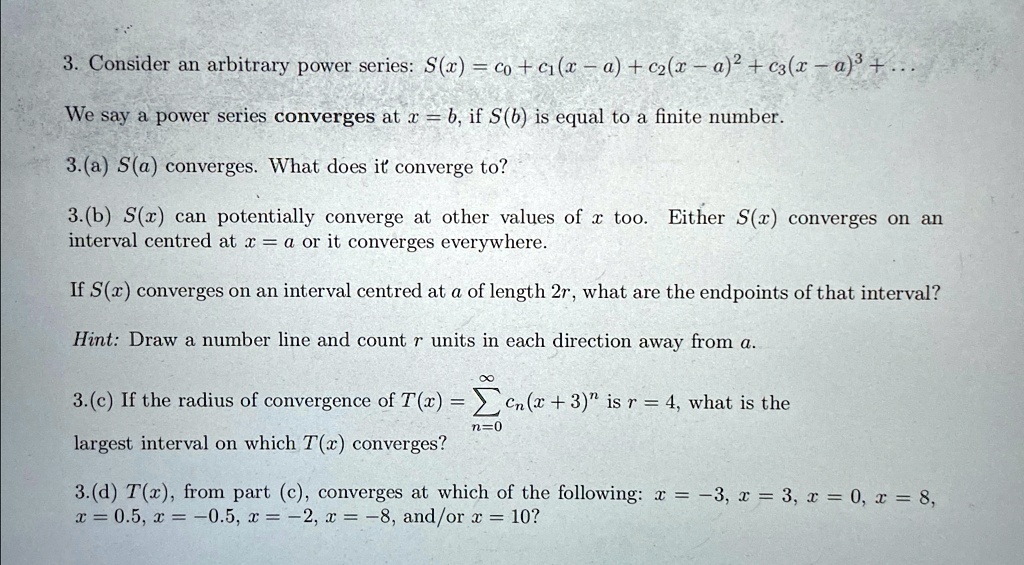
3. Consider an arbitrary power series: $S(x) = c_0 + c_1(x-a) + c_2(x-a)^2 + c_3(x-a)^3 + ...$
We say a power series converges at $x = b$, if $S(b)$ is equal to a finite number.
3.(a) $S(a)$ converges. What does it converge to?
3.(b) $S(x)$ can potentially converge at other values of $x$ too. Either $S(x)$ converges on an
interval centred at $x = a$ or it converges everywhere.
If $S(x)$ converges on an interval centred at $a$ of length $2r$, what are the endpoints of that interval?
Hint: Draw a number line and count $r$ units in each direction away from $a$.
3.(c) If the radius of convergence of $T(x) = \sum_{n=0}^{\infty} c_n(x+3)^n$ is $r = 4$, what is the
largest interval on which $T(x)$ converges?
3.(d) $T(x)$, from part (c), converges at which of the following: $x = -3$, $x = 3$, $x = 0$, $x = 8$,
$x = 0.5$, $x = -0.5$, $x = -2$, $x = -8$, and/or $x = 10$?