Exercise 3-1
For the function y=x^(2)-(x)/(x+3), calculate the value of y for the following values of x using element-by-element operations: 0, 1, 2, 3, 4, 5, 6, 7.
Exercise 3-2
Define the vector v. Then use the vector in a mathematical expression to create the following vectors:
(a) a=[3,9,15,21]
(b) b=[1,9,25,49]
(c) c=[1,1,1,1]
(d) d=[6,6,6,6]
Exercise 3-3
Define the vectors:
a=7i-4j+6k, b=-4i+7j+5k, and c=5i-6j+8k
Use the vectors to verify the identity:
a x (b x c)=b(a c)-c(a b)
Use MATLAB's built-in functions cross and dot, calculate the value of the left and right sides of the identity.
Exercise 3-4
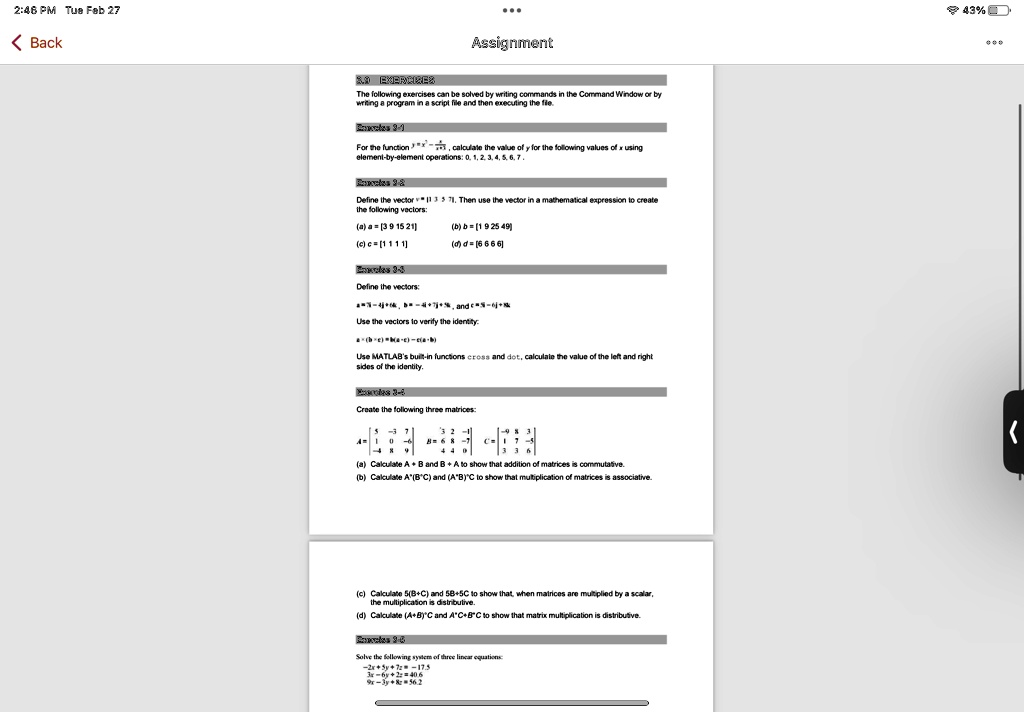
Create the following three matrices:
(a) Calculate A+B and B+A to show that addition of matrices is commutative.
(b) Calculate A*(B*C) and (A*B)*C to show that multiplication of matrices is associative.
(c) Calculate 5(B+C) and 5B+5C to show that, when matrices are multiplied by a scalar, the multiplication is distributive.
(d) Calculate (A+B)*C and A*C+B*C to show that matrix multiplication is distributive.
Exercise 3-5
Solve the following system of three linear equations:
-2x+5y+7z=-17.5
3x-6y+2z=40.6
9x-3y+8z=56.2