Ace - AI Tutor
Ask Our Educators
Textbooks
My Library
Flashcards
Scribe - AI Notes
Notes & Exams
Download App
richard anthony

richard a.

Divider

Questions asked

BEST MATCH

the reaction of butane with CL2 in the presence of light forms two different alkyl chlorides

View Answer
divider
BEST MATCH

College students were given three choices of pizza toppings and asked to choose one favorite. The following table shows the results. toppings freshman sophomore junior senior cheese 10 10 28 25 meat 19 25 10 10 veggie 10 10 19 25 Find P(favorite topping is veggie | student is junior or senior). Round the answer to the nearest hundredth. A. .376 B. .219 C. .333 D. .688

View Answer
divider
BEST MATCH

In the the Figure, given R=578??, C=50.6µF, and V=39.6V. The switch has been open for a long time for an uncharged capacitor. It is then suddenly closed. Find the current passing through the resistor (unit in µA) at the moment after the switch is closed one time constant.

View Answer
divider
BEST MATCH

2. Solving the heat conduction IBVP for an insulated rod of length 1. The IBVP \begin{cases} U_t = U_{xx}, & \text{for } 0 < x < 1 \text{ and } t > 0; \\ u(x, 0) = f(x), & \text{for } 0 \le x \le 1; \\ u_x(0, t) = 0, & \text{for } t > 0; \\ u_x(1, t) = 0, & \text{for } t \ge 0, \end{cases} (6) models heat conduction in a fully insulated cylindrical rod of length 1 and constant cross-sectional area A. In this case, the thermal diffusivity of the material making up the rod is assumed to be D = 1. The function $f: [0,1] \to \mathbb{R}$ in the IBVP in (6) gives the initial temperature distribution in the rod at time $t = 0$. It is assumed that $f$ is continuous, piece-wise $C^1$, and with square integrable derivative. Assume also that $f'(0) = f'(1) = 0$. (a) Use separation of variables and the method of eigenfunction expansion to construct the solution of the IBVP in (6). (b) Let $u: [0, 1] \times [0, \infty) \to \mathbb{R}$ be the solution of the IBVP in (6). Show that $\lim_{t \to \infty} u(x, t)$ exists. (7) Compute the limit in (7) and give an interpretation of your result.

View Answer
divider
BEST MATCH

According to the horizontal - equity principle, governments favor taxes that A. place a greater share of the tax burden on those who have greater ability to pay. B. place a greater share of the tax burden on those who receive greater benefits. C. are regressive. D. divide the tax burden equally across people. E. treat people in the same economic situation equally.

View Answer
divider
BEST MATCH

The .values() dictionary method in Python returns the keys of a dictionary as a tuple.

View Answer
divider
BEST MATCH

Find the length of BD in kite ABCD. 6 m 8 m 21 m 15 m Question 23 B 6 m 10 m A C D 17 m Consider the quadrilateral JKLM with vertices at J(0, 0), K(6, 0), L(6, 4), and M(0, 4). Quadrilateral JKLM can be identified as which of the following? I. a square II. a rhombus III. a parallelogram OI only O III only I and III only OI, II, and III 2.95 pts

View Answer
divider
BEST MATCH

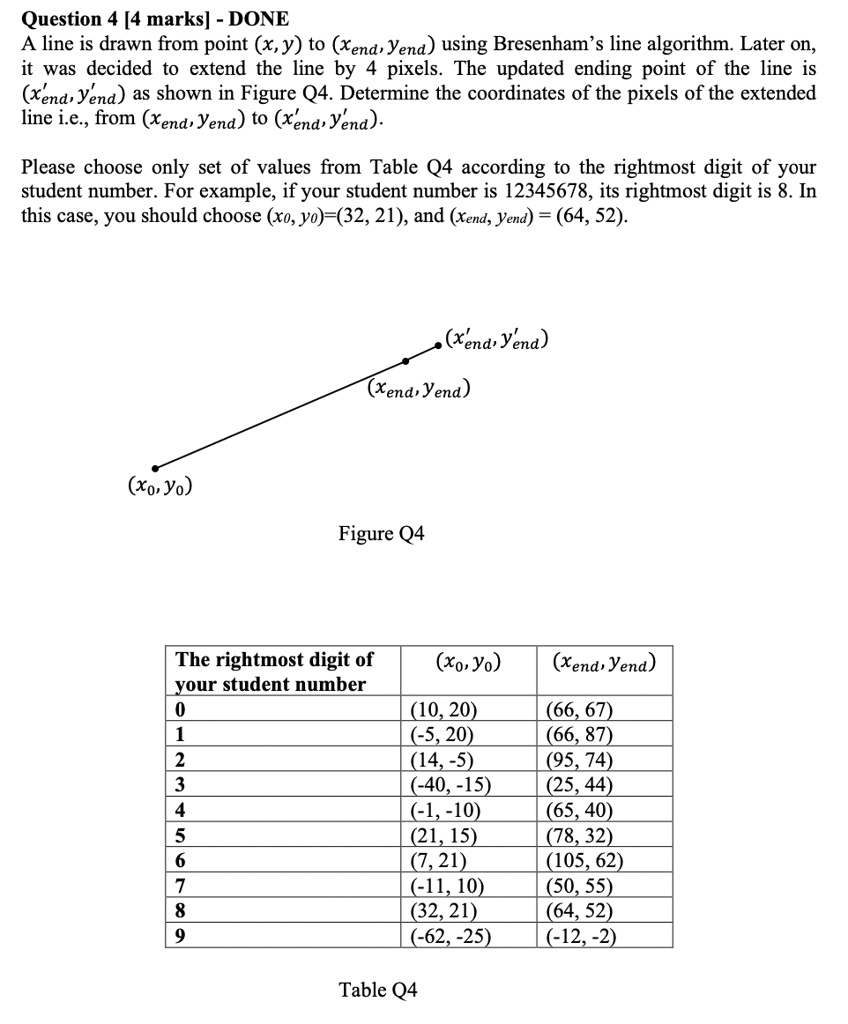
Question 4 [4 marks] - DONE A line is drawn from point ($x, y$) to ($x_{end}, y_{end}$) using Bresenham's line algorithm. Later on, it was decided to extend the line by 4 pixels. The updated ending point of the line is ($x'_{end}, y'_{end}$) as shown in Figure Q4. Determine the coordinates of the pixels of the extended line i.e., from ($x_{end}, y_{end}$) to ($x'_{end}, y'_{end}$). Please choose only set of values from Table Q4 according to the rightmost digit of your student number. For example, if your student number is 12345678, its rightmost digit is 8. In this case, you should choose ($x_0, y_0$)=(32, 21), and ($x_{end}, y_{end}$) = (64, 52). ($x'_{end}, y'_{end}$) ($x_{end}, y_{end}$) ($x_0, y_0$) Figure Q4 The rightmost digit of ($x_0, y_0$) ($x_{end}, y_{end}$) your student number 0 (10, 20) (66, 67) 1 (-5, 20) (66, 87) 2 (14, -5) (95, 74) 3 (-40, -15) (25, 44) 4 (-1, -10) (65, 40) 5 (21, 15) (78, 32) 6 (7, 21) (105, 62) 7 (-11, 10) (50, 55) 8 (32, 21) (64, 52) 9 (-62, -25) (-12, -2) Table Q4
View Answer
divider
BEST MATCH

The wire antenna given in the figure is radiated-near-field (Fresnel) and far-field (Far-field) at 2 GHz Find out where their range started.

View Answer
divider
BEST MATCH

b. What is the name of the chewing muscle that passes beneath the zygomatic arch and attaches to the superior portion of the mandible?

View Answer
divider