Ace - AI Tutor
Ask Our Educators
Textbooks
My Library
Flashcards
Scribe - AI Notes
Notes & Exams
Download App
richard ferguson

richard f.

Divider

Questions asked

BEST MATCH

Solve for y in terms of x. 7x − 5y = −2

View Answer
divider
BEST MATCH

Which molecular formula corresponds to an alkyne? A $C_2H_4$ B $C_7H_{16}$ C $C_4H_{10}$ D $C_8H_{18}$ E $C_9H_{16}$

View Answer
divider
BEST MATCH

3. a. Reinforced concrete with a length of 12 meters and a diameter of 6 mm, will be formed into 2 basic foundation shapes, namely: a right triangle shape and an equilateral hexagon shape. Prove that the image below has an objective function: min f(x) = 0.079x^2 - 0.866x + 5.196 x b b 12-x It is known that the area of an equilateral hexagon is L $L = \frac{3\sqrt{3}xa^2}{2}$ b. How long should each form of foundation be so that the total area is minimum?

View Answer
divider
BEST MATCH

A patient presents with symptoms of muscle cramps, tingling in the fingers, and tetany. Lab results reveal low plasma calcium and elevated plasma phosphate levels. Which condition is most likely responsible for these findings? Currently Selected: B A Primary hyperparathyroidism B Hypoparathyroidism c Secondary hyperparathyroidism D Pseudohypoparathyroidism

View Answer
divider
BEST MATCH

Directions: Solve the following problems. Be sure to check with your lab/recitation instructor about what is required. Will you have to turn in a project report? If so, when will it be due? Is there a required format for the report? Be clear on what is expected before your group starts to work. This project is designed to help you better visualize the action of a matrix in geometric terms. It also shows how to take advantage of the matrix representation of a linear transformation. 1. Give a geometric description in words and with sketches of the transformation \( T: \mathbb{R}^{3} \rightarrow \mathbb{R}^{3} \) that is multiplication by the matrix \[ A=\left[\begin{array}{rrr} 1 & 0 & 0 \\ 0 & -1 & 0 \\ 0 & 0 & 1 \end{array}\right] \] 2. Give a geometric description in words and with sketches of the transformation \( T: \mathbb{R}^{3} \rightarrow \mathbb{R}^{2} \) that is multiplication by the matrix \[ A=\left[\begin{array}{rrr} 1 & 0 & 0 \\ 0 & -1 & 0 \end{array}\right] \] 3. Do the following: (a) Find the matrix of the linear transformation \( T: \mathbb{R}^{2} \rightarrow \mathbb{R}^{2} \) where \( T(\mathbf{v}) \) is the reflection of \( \mathbf{v} \) across the line \( y=(1 / 2) x \). (b) Find the reflection of the vector \( [23]^{T} \) across the line \( y=(1 / 2) x \). 4. Let \( \mathbf{a}=\left[\begin{array}{lll}1 & 2 & 3\end{array}\right]^{T} \) and define a linear transformation \( T: \mathbb{R}^{3} \rightarrow \mathbb{R}^{3} \) as follows: For each position vector \( \mathbf{v} \) in \( \mathbb{R}^{3} \) let \( T(\mathbf{v}) \) be the position vector with the property that the line segment from the tip of \( \mathbf{v} \) to the tip of \( T(\mathbf{v}) \) is parallel to a and such that the tip of \( T(\mathbf{v}) \) is in the \( x y \)-plane. Do the following: (a) Find the matrix \( A \) of \( T \). (b) Determine whether or not \( A \) is a projection matrix. If it is, is it an orthogonal projection? Explain.

View Answer
divider
BEST MATCH

The second heart sound "dub" immediately follows the occurrence of the T wave. During this time of ventricular repolarization, the ventricles are in diastole. Meanwhile, blood is now either in the aorta or the pulmonary artery. Thus, the pressure is now greater in the aorta and pulmonary artery, causing the the semilunar valves to slam shut, creating the "dub" sound. O True O False

View Answer
divider
BEST MATCH

Write $\log_a 2 + \frac{1}{2}\log_a 3 - 2\log_a 5$ as the logarithm of a single value with base a. Show the steps on your paper. Select one:

View Answer
divider
BEST MATCH

How does this flowchart of the process of science compare to what you learned in high school science classes about the scientific method?

View Answer
divider
BEST MATCH

Question 5 Consider the circuit shown. Assume that the op-amps are ideal, R=100Omega , and R_(L)=150Omega . What is i_(0) for v_(I1)=0.25V, and v_(I2)=-0.25V ? (8 points) Question 5 Consider the circuit shown. Assume that the op-amps are ideal, R =100 Q,and R=150 Q + Us 0ao What is io for V11 = 0.25 V, and vi2 = -0.25 V? (8 points) MWM RL 112

View Answer
divider
BEST MATCH

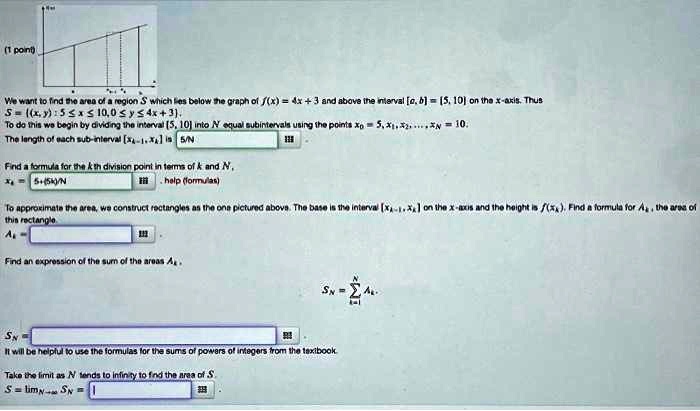
(1 point) We want to find the area of a region S which lies below the graph of $f(x) = 4x + 3$ and above the interval $[a, b] = [5, 10]$ on the x-axis. Thus $S = \{(x, y) : 5 \le x \le 10, 0 \le y \le 4x + 3\}$. To do this we begin by dividing the interval $[5, 10]$ into $N$ equal subintervals using the points $x_0 = 5, x_1, x_2, \dots, x_N = 10$. The length of each sub-interval $[x_{k-1}, x_k]$ is $\frac{5}{N}$ Find a formula for the $k^{th}$ division point in terms of $k$ and $N$. $x_k = 5 + \frac{5k}{N}$ help (formulas) To approximate the area, we construct rectangles as the one pictured above. The base is the interval $[x_{k-1}, x_k]$ on the x-axis and the height is $f(x_k)$. Find a formula for $A_k$, the area of this rectangle. $A_k = $ Find an expression of the sum of the areas $A_k$. $S_N = \sum_{k=1}^N A_k$ It will be helpful to use the formulas for the sums of powers of integers from the textbook. Take the limit as $N$ tends to infinity to find the area of $S$ $S = \lim_{N \to \infty} S_N = $
View Answer
divider