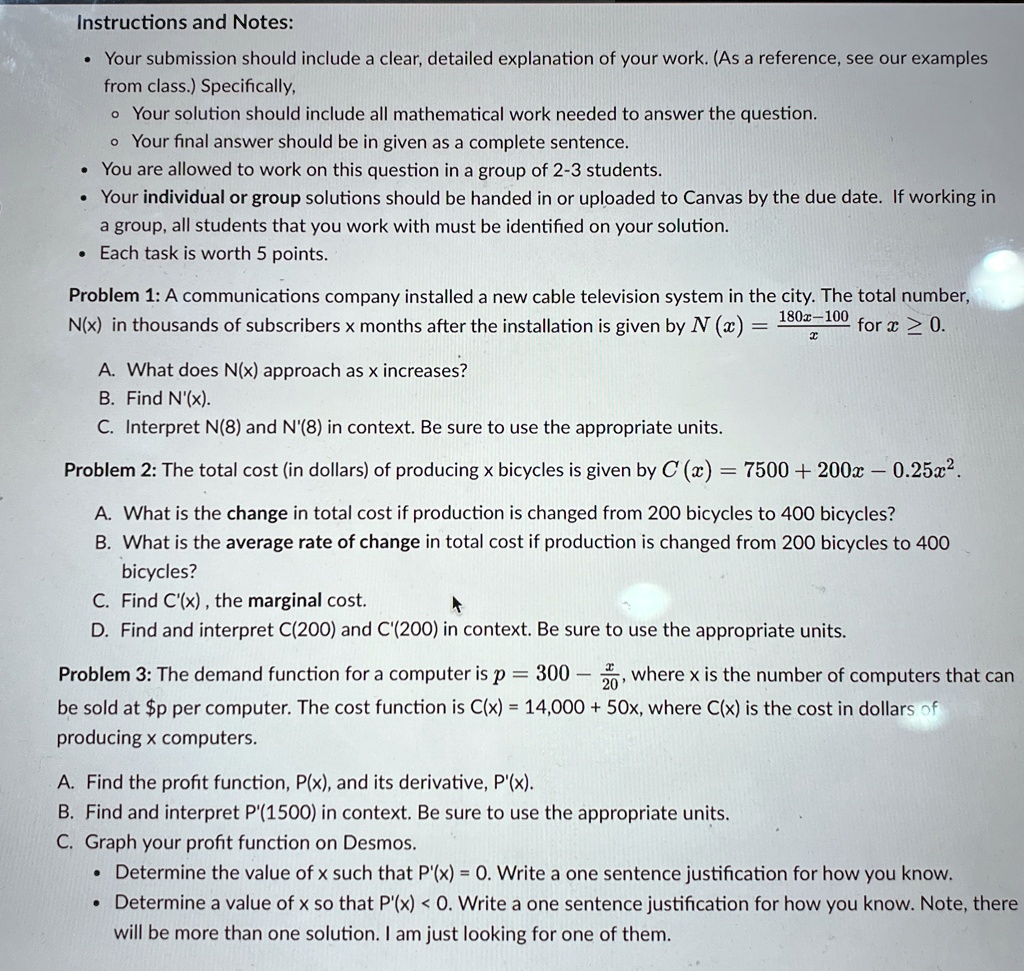
Problem 1: A communications company installed a new cable television system in the city. The total number,
N(x) in thousands of subscribers x months after the installation is given by $N(x) = \frac{180x - 100}{x}$ for $x \ge 0$.
A. What does N(x) approach as x increases?
B. Find N'(x).
C. Interpret N(8) and N'(8) in context. Be sure to use the appropriate units.
Problem 2: The total cost (in dollars) of producing x bicycles is given by $C(x) = 7500 + 200x - 0.25x^2$.
A. What is the change in total cost if production is changed from 200 bicycles to 400 bicycles?
B. What is the average rate of change in total cost if production is changed from 200 bicycles to 400
bicycles?
C. Find C'(x), the marginal cost.
D. Find and interpret C(200) and C'(200) in context. Be sure to use the appropriate units.
Problem 3: The demand function for a computer is $p = 300 - \frac{x}{20}$, where x is the number of computers that can
be sold at $p per computer. The cost function is $C(x) = 14,000 + 50x$, where C(x) is the cost in dollars of
producing x computers.
A. Find the profit function, P(x), and its derivative, P'(x).
B. Find and interpret P'(1500) in context. Be sure to use the appropriate units.
C. Graph your profit function on Desmos.
• Determine the value of x such that P'(x) = 0. Write a one sentence justification for how you know.
• Determine a value of x so that P'(x) < 0. Write a one sentence justification for how you know. Note, there
will be more than one solution. I am just looking for one of them.