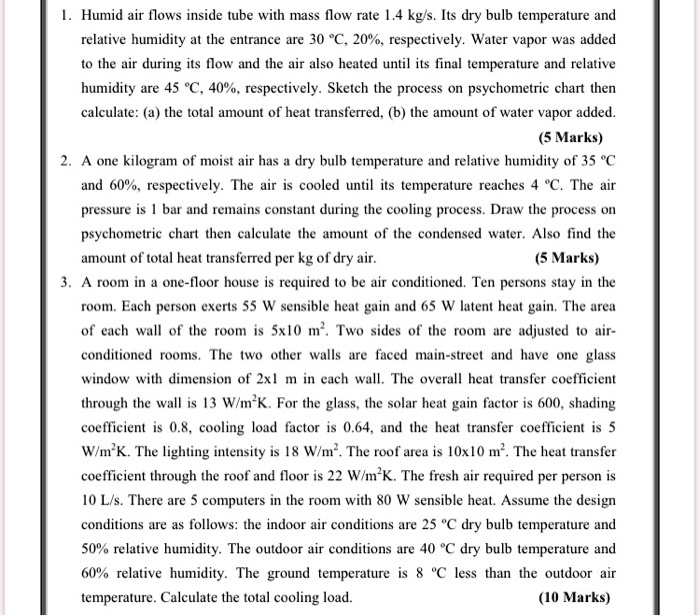
Humid air flows inside a tube with a mass flow rate of 1.4 kg/s. Its dry bulb temperature and relative humidity at the entrance are 30°C and 20%, respectively. Water vapor was added to the air during its flow, and the air was also heated until its final temperature and relative humidity are 45°C and 40%, respectively. Sketch the process on a psychometric chart, then calculate: (a) the total amount of heat transferred, (b) the amount of water vapor added.
2. Corrected_text: One kilogram of moist air has a dry bulb temperature and relative humidity of 35°C and 60%, respectively. The air is cooled until its temperature reaches 4°C. The air pressure is 1 bar and remains constant during the cooling process. Draw the process on a psychometric chart, then calculate the amount of condensed water. Also, find the amount of total heat transferred per kg of dry air.
3. Corrected_text: A room in a one-floor house is required to be air-conditioned. Ten persons stay in the room. Each person exerts 55 W sensible heat gain and 65 W latent heat gain. The area of each wall of the room is 5x10 m. Two sides of the room are adjusted to air-conditioned rooms. The two other walls are faced main street and have one glass window with dimensions of 2x1 m in each wall. The overall heat transfer coefficient through the wall is 13 W/mK. For the glass, the solar heat gain factor is 600, the shading coefficient is 0.8, the cooling load factor is 0.64, and the heat transfer coefficient is 5 W/mK. The lighting intensity is 18 W/m². The roof area is 10x10 m². The heat transfer coefficient through the roof and floor is 22 W/mK. The fresh air required per person is 10 L/s. There are 5 computers in the room with 80 W sensible heat. Assume the design conditions are as follows: the indoor air conditions are 25°C dry bulb temperature and 50% relative humidity. The outdoor air conditions are 40°C dry bulb temperature and 60% relative humidity. The ground temperature is 8°C less than the outdoor air temperature. Calculate the total cooling load.