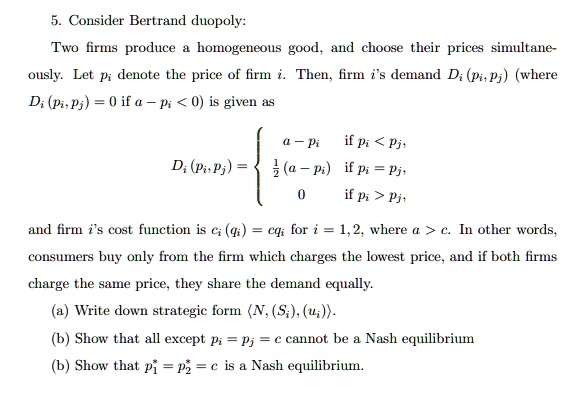
5. Consider Bertrand duopoly:
Two firms produce a homogeneous good, and choose their prices simultane-
ously. Let $p_i$ denote the price of firm $i$. Then, firm $i$'s demand $D_i(p_i, p_j)$ (where
$D_i(p_i, p_j) = 0$ if $a - p_i < 0$) is given as
$D_i(p_i, p_j) = \begin{cases} a - p_i & \text{if } p_i < p_j, \\ \frac{1}{2}(a - p_i) & \text{if } p_i = p_j, \\ 0 & \text{if } p_i > p_j, \end{cases}$
and firm $i$'s cost function is $c_i(q_i) = cq_i$ for $i = 1, 2$, where $a > c$. In other words,
consumers buy only from the firm which charges the lowest price, and if both firms
charge the same price, they share the demand equally.
(a) Write down strategic form $(N, (S_i), (u_i)).$
(b) Show that all except $p_1 = p_j = c$ cannot be a Nash equilibrium
(b) Show that $p_1^* = p_2^* = c$ is a Nash equilibrium.