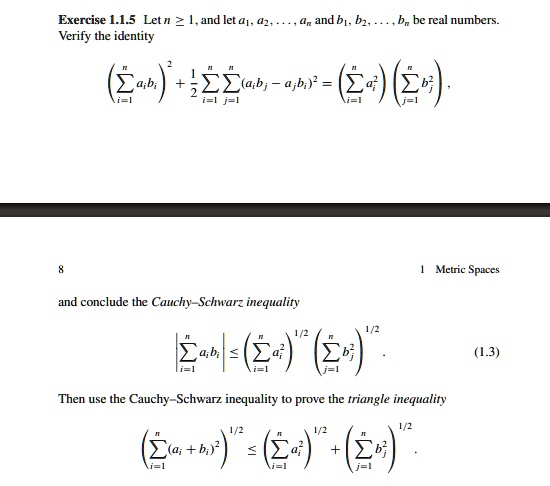
Exercise 1.1.5 Let $n \ge 1$, and let $a_1, a_2, \dots, a_n$ and $b_1, b_2, \dots, b_n$ be real numbers.
Verify the identity
$\left(\sum_{i=1}^n a_i b_i \right)^2 + \frac{1}{2} \sum_{i=1}^n \sum_{j=1}^n (a_i b_j - a_j b_i)^2 = \left(\sum_{i=1}^n a_i^2 \right) \left(\sum_{j=1}^n b_j^2 \right)$.
and conclude the Cauchy-Schwarz inequality
$\left| \sum_{i=1}^n a_i b_i \right| \le \left( \sum_{i=1}^n a_i^2 \right)^{1/2} \left( \sum_{j=1}^n b_j^2 \right)^{1/2}$.
(1.3)
Then use the Cauchy-Schwarz inequality to prove the triangle inequality
$\left( \sum_{i=1}^n (a_i + b_i)^2 \right)^{1/2} \le \left( \sum_{i=1}^n a_i^2 \right)^{1/2} + \left( \sum_{j=1}^n b_j^2 \right)^{1/2}$.