Chapter 4
1. explain the characteristics of memory systems
Table 4.1 Key Characteristics of Computer Memory Systems
\begin{tabular}{|lc|}
\hline Location & Performance \\
Internal (c.g., processor registers, cache, main & Access time \\
memory) & Cycle time \\
External (e.g., optical disks, magnetic & Transfer rate \\
disks, tapes) & Physical Type \\
Capacity & Semiconductor \\
Number of words & Magnetic \\
Number of bytes & Optical \\
Unit of Transfer & Magneto-optical \\
Word & Physical Characteristic \\
Block & Volatile/nonvolatile \\
Access Method & Erasable/nonerasable \\
Scquential & Orranization \\
Direct & Memory modules \\
Random & \\
Associative & \\
\hline
\end{tabular}
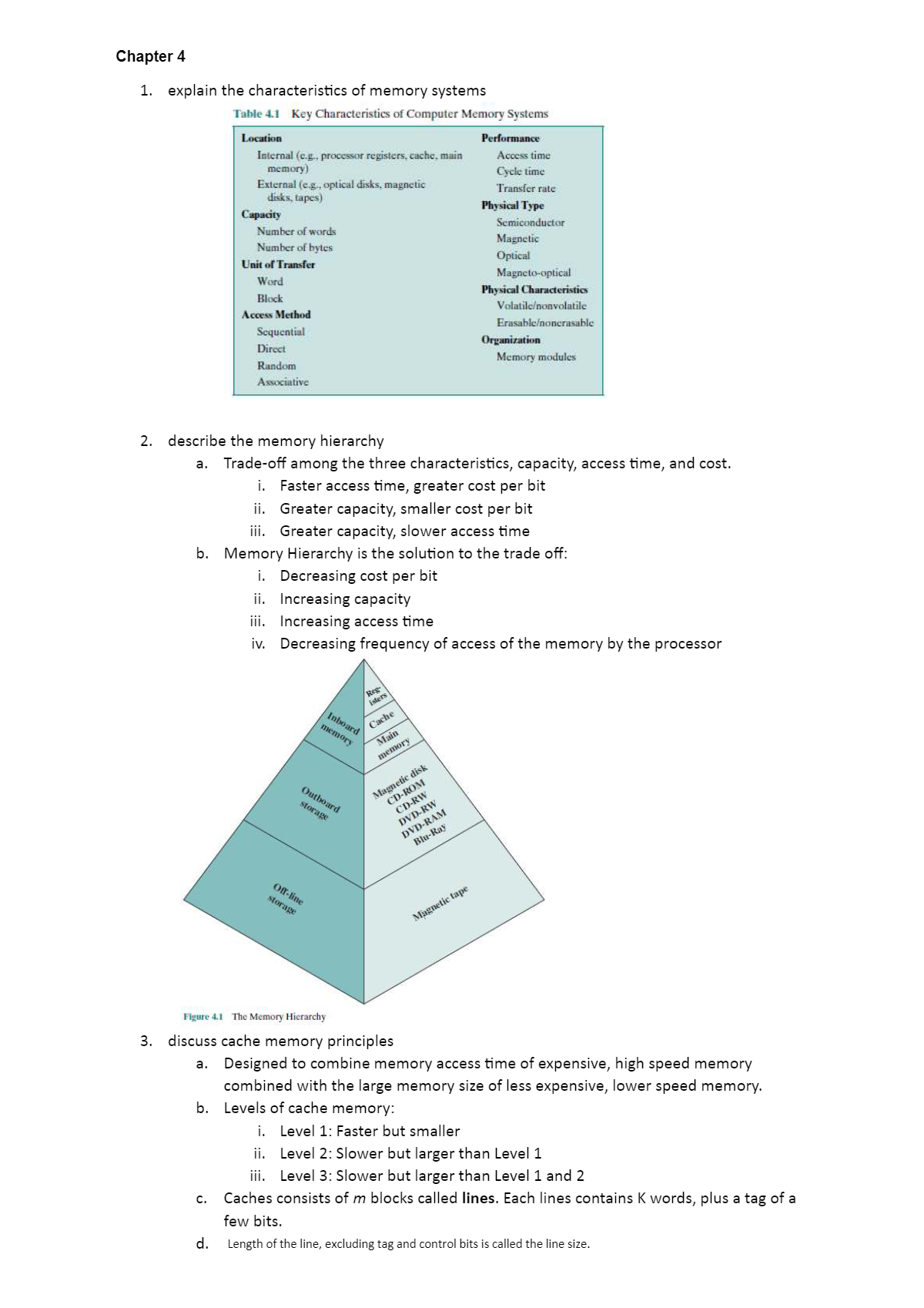
2. describe the memory hierarchy
a. Trade-off among the three characteristics, capacity, access time, and cost.
i. Faster access time, greater cost per bit
ii. Greater capacity, smaller cost per bit
iii. Greater capacity, slower access time
b. Memory Hierarchy is the solution to the trade off:
i. Decreasing cost per bit
ii. Increasing capacity
iii. Increasing access time
iv. Decreasing frequency of access of the memory by the processor
Figure 4.1 The Memory Hierarchy
3. discuss cache memory principles
a. Designed to combine memory access time of expensive, high speed memory combined with the large memory size of less expensive, lower speed memory.
b. Levels of cache memory:
i. Level 1: Faster but smaller
ii. Level 2: Slower but larger than Level 1
iii. Level 3: Slower but larger than Level 1 and 2
c. Caches consists of \( m \) blocks called lines. Each lines contains \( \mathrm{K} \) words, plus a tag of a few bits.
d. Length of the line, excluding tag and control bits is called the line size.