Required Information
Exercise 7- Calculating and Comparing Return on Invested Capital (ROIC) Apple v. Microsoft
Return on Invested Capital (ROIC) is a profitability ratio that measures how effective the firm is at generating a return for
Investors who have provided capital (bondholders and stockholders). The ROIC calculation answers three questions: How
tax efficient is the firm? How effective are the firm's operations? How Intensively does the firm use capital? Comparing the
answers to these questions between firms can help you understand why one firm is more profitable than another and
where that profitability is coming from.
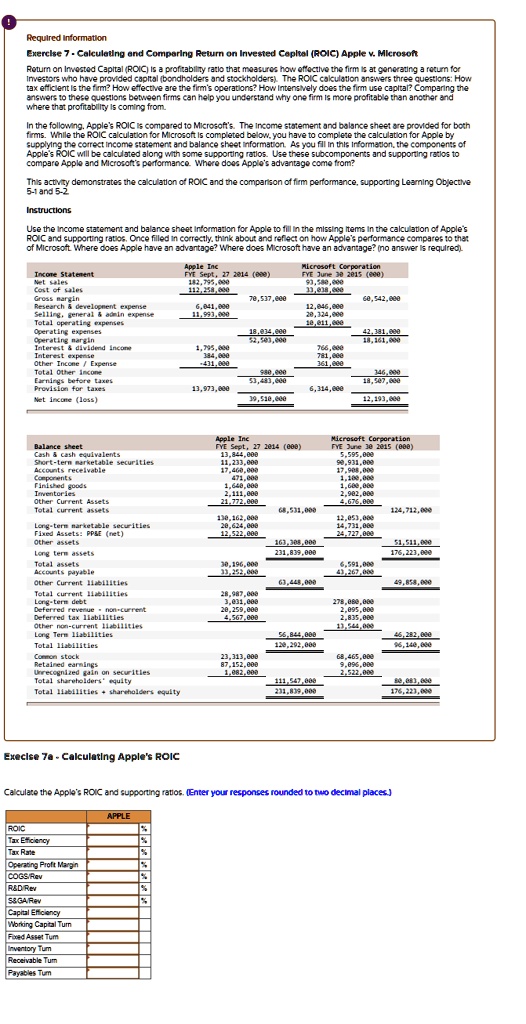
In the following, Apple's ROIC is compared to Microsoft's. The income statement and balance sheet are provided for both
firms. While the ROIC calculation for Microsoft is completed below, you have to complete the calculation for Apple by
supplying the correct income statement and balance sheet Information. As you fill in this Information, the components of
Apple's ROIC will be calculated along with some supporting ratios. Use these subcomponents and supporting ratios to
compare Apple and Microsoft's performance. Where does Apple's advantage come from?
This activity demonstrates the calculation of ROIC and the comparison of firm performance, supporting Learning Objective
5-1 and 5-2
Instructions
Use the Income statement and balance sheet Information for Apple to fill in the missing items in the calculation of Apple's
ROIC and supporting ratios. Once filled in correctly, think about and reflect on how Apple's performance compares to that
of Microsoft. Where does Apple have an advantage? Where does Microsoft have an advantage? (no answer is required).
Income Statement
Net sales
Cost of sales
Gross margin
Research & development expense
Selling, general & admin expense
Total operating expenses
Operating expenses
Operating margin
Interest & dividend Income
Interest expense
Other Income / Expense
Total Other Income
Earnings before taxes
Provision for taxes
Net income (loss)
Apple Inc
FYE Sept, 27 2014 (000)
Microsoft Corporation
FYE June 30 2015 (000)
182,795,000
93,580,000
112,258,000
33,038,000
78,537,000
60,542,000
6,041,000
12,046,000
11,993,000
20,324,000
18,034,000
42,381,000
52,503,000
18,161,000
1,795,000
766,000
384,000
781,000
-431,000
361,000
980,000
346,000
53,483,000
18,507,000
13,973,000
6,314,000
39,510,000
12,193,000
Balance sheet
Cash & cash equivalents
Short-term marketable securities
Accounts receivable
Components
Finished goods
Inventories
Other Current Assets
Total current assets
Long-term marketable securities
Fixed Assets: PP&E (net)
Other assets
Long term assets
Total assets
Accounts payable
Other Current liabilities
Total current liabilities
Long-term debt
Deferred revenue - non-current
Deferred tax liabilities
Other non-current liabilities
Long Term liabilities
Total liabilities
Common stock
Retained earnings
Unrecognized gain on securities
Total shareholders' equity
Total liabilities + shareholders equity
Apple Inc
FYE Sept, 27 2014 (000)
Microsoft Corporation
FYE June 30 2015 (000)
13,844,000
5,595,000
11,233,000
90,931,000
17,460,000
17,908,000
471,000
1,100,000
1,640,000
1,600,000
2,111,000
2,902,000
21,772,000
4,676,000
68,531,000
124,712,000
130,162,000
12,053,000
20,624,000
14,731,000
12,522,000
24,727,000
163,308,000
51,511,000
231,839,000
176,223,000
30,196,000
6,591,000
33,252,000
43,267,000
63,448,000
49,858,000
28,987,000
278,080,000
3,031,000
2,095,000
20,259,000
2,835,000
4,567,000
13,544,000
56,844,000
46,282,000
120,292,000
96,140,000
23,313,000
68,465,000
87,152,000
9,096,000
1,082,000
2,522,000
111,547,000
80,083,000
231,839,000
176,223,000
Execise 7a - Calculating Apple's ROIC
Calculate the Apple's ROIC and supporting ratios. (Enter your responses rounded to two decimal places.)
ROIC
Tax Efficiency
Tax Rate
Operating Profit Margin
COGS/Rev
R&D/Rev
S&GA/Rev
Capital Efficiency
Working Capital Turn
Fixed Asset Tum
Inventory Tum
Receivable Tum
Payables Tum
APPLE
%
%
%
%
%
%