Q46. You have to answer 1 question; Please only answer this question if you are confident in providing a correct and high-quality response. The answer must be complete. Also, please do not use chatgpt. It's a question from Topology. Your expertise is highly appreciated. Thank you.
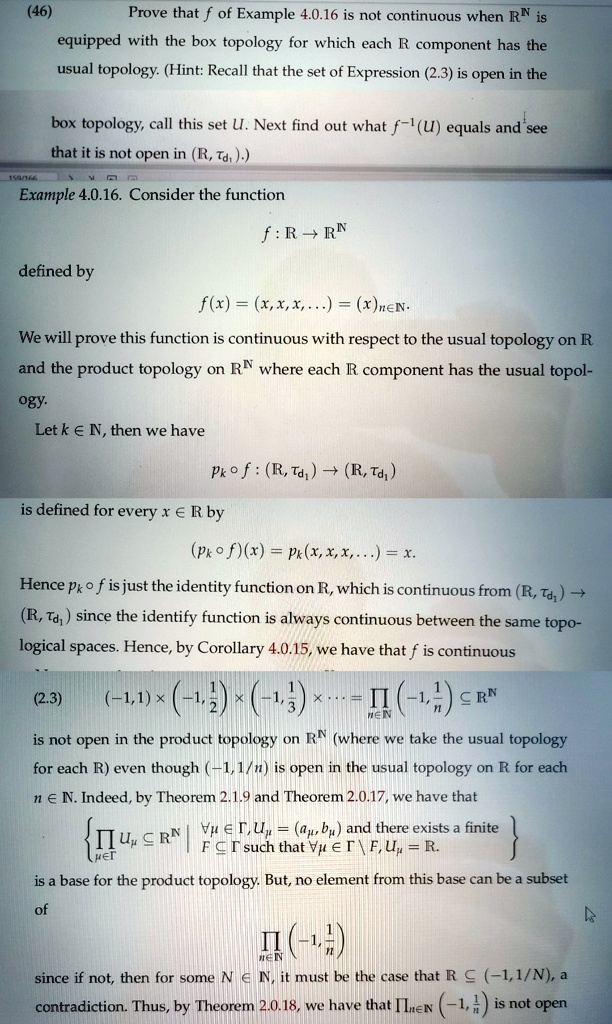
(46) Prove that f of Example 4.0.16 is not continuous when RN is equipped with the box topology for which each R component has the usual topology. (Hint: Recall that the set of Expression (2.3) is open in the box topology, call this set U. Next find out what f-1(U) equals and see that it is not open in (R, Ta).)
Example 4.0.16. Consider the function
f: RRN
defined by
f(x) = x1, x2, x3... = xn ∈ N.
We will prove this function is continuous with respect to the usual topology on R and the product topology on RN where each R component has the usual topology. Let k ∈ N, then we have
P(k) ∈ (R, Td) → (R, Ta)
is defined for every x ∈ R by
p(k)(f(x)) = p(k)(x1, x2, x3) = xk
Hence, p(f) is just the identity function on R, which is continuous from (R, Td) to (R, Ta) since the identity function is always continuous between the same topological spaces. Hence, by Corollary 4.0.15, we have that f is continuous.
Expression (2.3)
f-1(U) is not open in the product topology on RN where we take the usual topology for each R even though it is open in the usual topology on R for each n ∈ N. Indeed, by Theorem 2.1.9 and Theorem 2.0.17 we have that
F(T) such that ∀U ∈ F(U) = R.
U ∈ F(T)
is a base for the product topology. But, no element from this base can be a subset of f-1(U) since if not, then for some N ∈ N it must be the case that R - 1, 1/N, a contradiction. Thus, by Theorem 2.0.18 we have that f-1(U) is not open.