Section:
Lab 11: Flame Tests and Atomic Emission Spectra
Pre-Lab Assignment
Rank the following colors of visible light according to increasing energy: Red, Green, Blue.
In other words, the color of light that is lowest energy is listed first, and the color of light that is highest in energy is listed last.
2. The most intense line in the emission spectrum for sodium appears at a wavelength of 589 nm. What color would you expect to observe when a solution that contains sodium ions is heated strongly in the flame of a Bunsen burner?
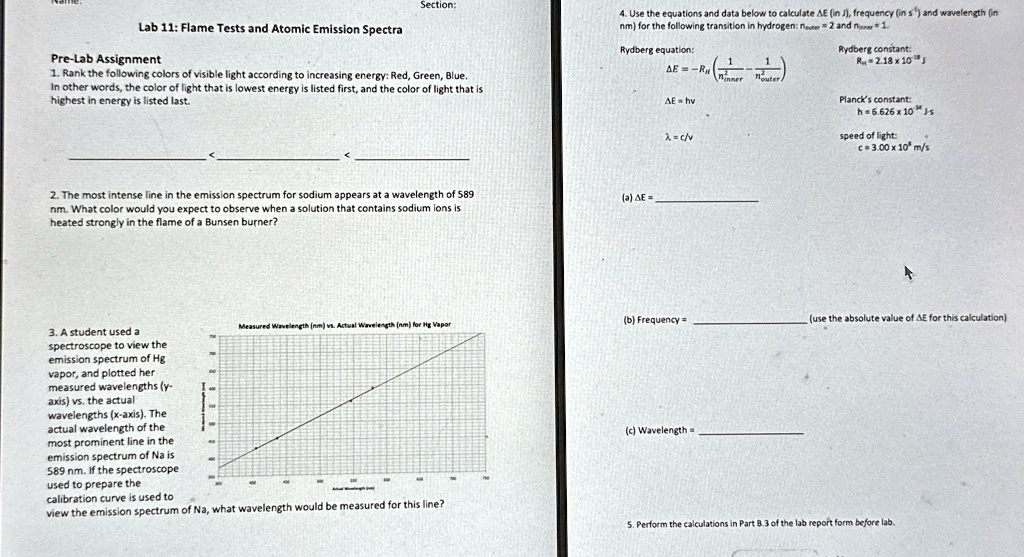
3. A student used a spectroscope to view the emission spectrum of Hg vapor, and plotted her measured wavelengths (y-axis) vs. the actual wavelengths (x-axis). The actual wavelength of the most prominent line in the emission spectrum of Na is 589 nm. If the spectroscope used to prepare the calibration curve is used to view the emission spectrum of Na, what wavelength would be measured for this line?
4. Use the equations and data below to calculate ΔE (in J), frequency (in s^(-1)), and wavelength (in nm) for the following transition in hydrogen: n_(outer)=2 and n_(inner)=1.
Rydberg equation:
ΔE = -R_(H)((1)/(n_(inner)^(2)) - (1)/(n_(outer)^(2)))
ΔE = hv
λ = (c)/(v)
Rydberg constant:
R_(H) = 2.18 x 10^(-18) J
Planck's constant:
h = 6.626 x 10^(-34) J/s
Speed of light:
c = 3.00 x 10^(8) m/s
(a) ΔE =
(b) Frequency = (use the absolute value of ΔE for this calculation)
(c) Wavelength =
5. Perform the calculations in Part B.3 of the lab report form before lab.