?05??
lop Math Algebra Support
View an example | All parts showing
Question 6, 5.
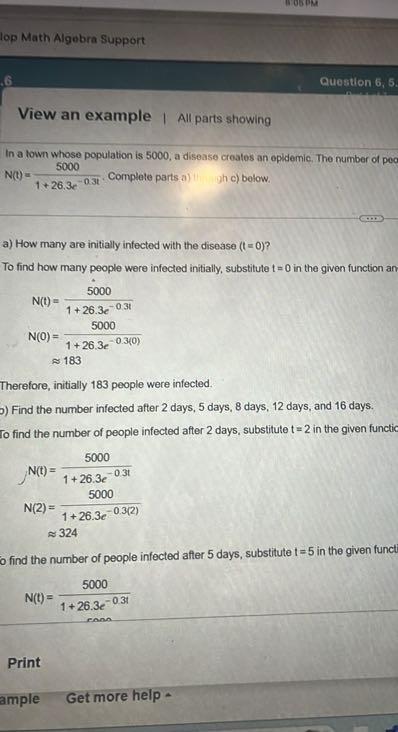
In a town whose population is 5000 , a disease creates an epidemic. The number of peo \( \mathrm{N}(\mathrm{t})=\frac{5000}{1+26.3 \mathrm{e}^{-0.3 t}} \). Complete parts a) jh c) bolow.
a) How many are initially infected with the disease \( (t=0) \) ?
To find how many people were infected initially, substitute \( t=0 \) in the given function an
\[
\begin{aligned}
N(t) & =\frac{5000}{1+26.3 e^{-0.3 t}} \\
N(0) & =\frac{5000}{1+26.3 e^{-0.3(0)}} \\
& \approx 183
\end{aligned}
\]
Therefore, initially 183 people were infected.
) Find the number infected after 2 days, 5 days, 8 days, 12 days, and 16 days.
ro find the number of people infected after 2 days, substitute \( t=2 \) in the given functic
\[
\begin{aligned}
N(t) & =\frac{5000}{1+26.3 e^{-0.3 t}} \\
N(2) & =\frac{5000}{1+26.3 e^{-0.3(2)}} \\
& \approx 324
\end{aligned}
\]
find the number of people infected after 5 days, substitute \( t=5 \) in the given functi
\[
N(t)=\frac{5000}{1+26.3 e^{-0.3 t}}
\]
Print
ample
Get more help -