Ace - AI Tutor
Ask Our Educators
Textbooks
My Library
Flashcards
Scribe - AI Notes
Notes & Exams
Download App
robert briones

robert b.

Divider

Questions asked

BEST MATCH

Which of the following are the specific antigen binding parts of antibodies? O Complimentary determine regions (CDRs). O Fragment crystallizable (Fc). O Heavy chain variable (IGHV). O Immunoglobulin (Ig).

View Answer
divider
BEST MATCH

Which of the following statements are true about people with central sleep apnea? (Select all that apply.) They do not have frequent awakenings. They tend to feel tired during the day. They experience complete cessation of respiratory activity for brief periods of time. It can be caused by cerebral vascular disease.

View Answer
divider
BEST MATCH

Which of the following motives is least likely attributed to Freeland's restriction on free trade? Group of answer choices economic motives social motives cultural motives political motives

View Answer
divider
BEST MATCH

This week, we will drill into SQL SQL queries. For this discussion, create a two tables of your choice in SMSS and then insert a few records into each. Show your CREATE table and INSERT queries. Then, using SELECT: 1. Select a COUNT of the number of records in each table. 2. Select all records from the table. 3. Select specific fields from the table. 4. Select specific fields from the table using a where clause that specifies a desired condition. Show your SELECT queries and results. Finally, discuss when you might index the table and describe how you would create the index.

View Answer
divider
BEST MATCH

Write the most common way to express mass percentage concentration as a fraction. Include units.

View Answer
divider
BEST MATCH

The value of a house has grown from $220,000 at the beginning of last year to $243,500 now. Find the change and relative change in this value. Write the relative change as both a decimal and a percentage.

View Answer
divider
BEST MATCH

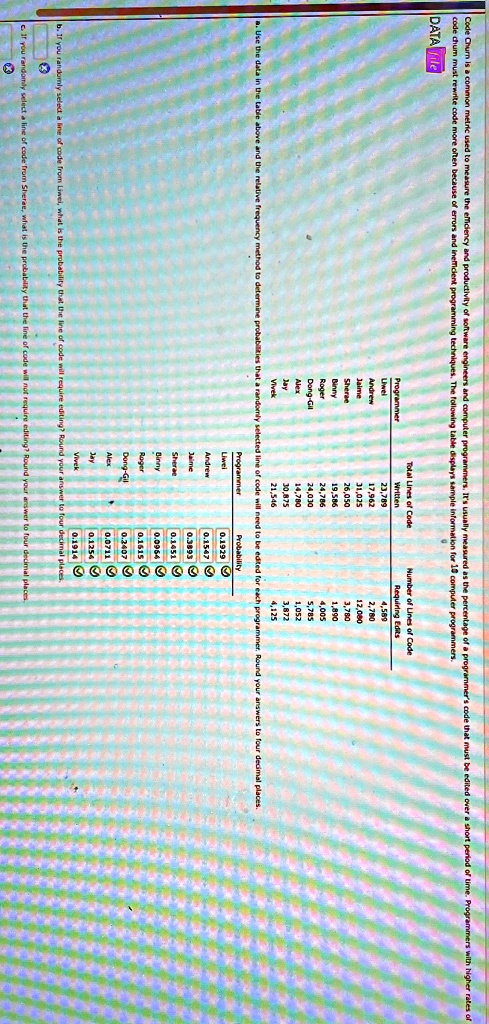
Code Churn is a common metric used to measure the efficiency and productivity of software engineers and computer programmers. It's usually measured as the percentage of a programmer's code that must be edited over a short period of time. Programmers with higher rates of code chum must rewrite code more often because of errors and inefficient programming techniques. The following table displays sample information for 10 computer programmers. DATA Total Lines of Code Programmer Written Number of Lines of Code Requiring Edits Liwel 23,789 4,589 Andrew 17,962 2,780 Jaime 31,025 12,080 Sherae 26,050 3,780 Binny 19,586 1,890 Roger 24,786 4,005 Dong-Gil 24,030 5,785 Alex 14,780 1,052 Vivek 30,875 3,872 21,546 4,125 Probability 0.1929 0.1547 0.3893 0.1451 0.0964 0.1615 0.2407 0.0711 0.1254 0.1914 Round your answers to four decimal places. b. If you randomly select a line of code from Liwel, what is the probability that the line of code will require editing? Round your answer to four decimal places. c. If you randomly select a line of code from Sherae, what is the probability that the line of code will require editing? Round your answer to four decimal places.
View Answer
divider
BEST MATCH

A screen 1.0mm behind a diffraction grating shows 5 bright spots. The first set of interference fringes is 43.6cm from the center point and the second set is an additional 89.7cm from the first set of fringes. The wavelength of light is 600nm. How many lines per millimeter does the grating have? A. Understand the problem - list the relevant quantities. For each quantity list a name, symbol, units, and either the given number or mark as unknown. B. Identify assumptions - write what you are assuming/idealizing about the diffraction grating and the light passing through it. Include here what model of light you're using and why it is applicable. C. Represent the situation physically - draw and label a diagram of the situation. An appropriate diagram should always be a professional representation that includes specific details helpful to the situation (not just a simple picture!). Include detailed labels for all crucial quantities related to or listed in part A. D. Represent principles symbolically - Write the name of any equations you'll use and write the equation. If there are conditions for this equation being used, explain how these are met. Be sure to indicate how the variables in the equation relate to what you listed in Part A (use the same letters or give a legend) E. Find unknown(s) symbolically - without numbers, find any unknown(s) in terms of symbols representing known quantities. F. Plug in numbers - plug numbers (with units) into your symbolic answer! G. Are the units correct? State the units you expect the unknown quantity to have. Show that the algebraic expression of your final answer reduces (cancels out) to have those same units. H. Is your numerical answer reasonable for the problem? Did you expect your final answer to be a scalar or a vector? Is that what you got? Relate this to the diffraction glasses you played with in class. Is your answer in the same ballpark as the range of those glasses? Be sure to explain how you conclude that. I. Does the physics of your symbolic answer match the real world physics? Analyze your symbolic solution. Use your real-world intuition to decide if number of lines per millimeter would increase/decrease if the distance from the central maximum to the next interference fringe would increase? Does your symbolic solution match this conclusion? (you may need to do some math to help you conclude this) Be sure to explain your reasoning. A screen 1.0 mm behind a diffraction grating shows 5 bright spots. The first set of interference fringes is 43.6 cm from the center point and the second set is an additional 89.7 cm from the first set of fringes. The wavelength of light is 600 nm. How many lines per millimeter does the grating have? A. Understand the problem -- list the relevant quantities. For each quantity list a name, symbol, units, and either the given number or mark as unknown. B. Identify assumptions -- write what you are assuming/idealizing about the diffraction grating and the light passing through it. Include here what model of light you're using and why it is applicable. C. Represent the situation physically -- draw and label a diagram of the situation. An specific details helpful to the situation (not just a simple picture!). Include detailed labels for all crucial quantities related to or listed in part A D. Represent principles symbolically -- Write the name of any equations you'll use and are met. Be sure to indicate how the variables in the equation relate to what you listed in Part A (use the same letters or give a legend) E. Find unknown(s) symbolically -- without numbers, find any unknown(s) in terms of symbols representing known quantities F. Plug in numbers -- plug numbers (with units) into your symbolic answer! G. Are the units correct? State the units you expect the unknown quantity to have. Show that the algebraic expression of your final answer reduces (cancels out) to have those same units. answer to be a scalar or a vector? Is that what you got? Relate this to the diffraction glasses you played with in class. Is your answer in the same ballpark as the range of those glasses? Be sure to explain how you conclude that. 1. Does the physics of your symbolic answer match the real world physics? Analyze your symbolic solution. Use your real-world intuition to decide if number of lines per millimeter would increase/decrease if the distance from the central maximum to the next interference fringe would increase? Does your symbolic solution match this conclusion? you may need to do some math to help you conclude this) Be sure to explain your reasoning.

View Answer
divider
BEST MATCH

Which of the following hormones primarily affects the reproductive organs? Multiple Choice Follicle-stimulating hormone Melatonin Thyrotropin Growth hormone Adrenocorticotropic hormone

View Answer
divider
BEST MATCH

Flooding attacks, take a variety of forms based on which network protocol is being used to implement the attack true or false

View Answer
divider