EXERCISE 3: Vector Transmission
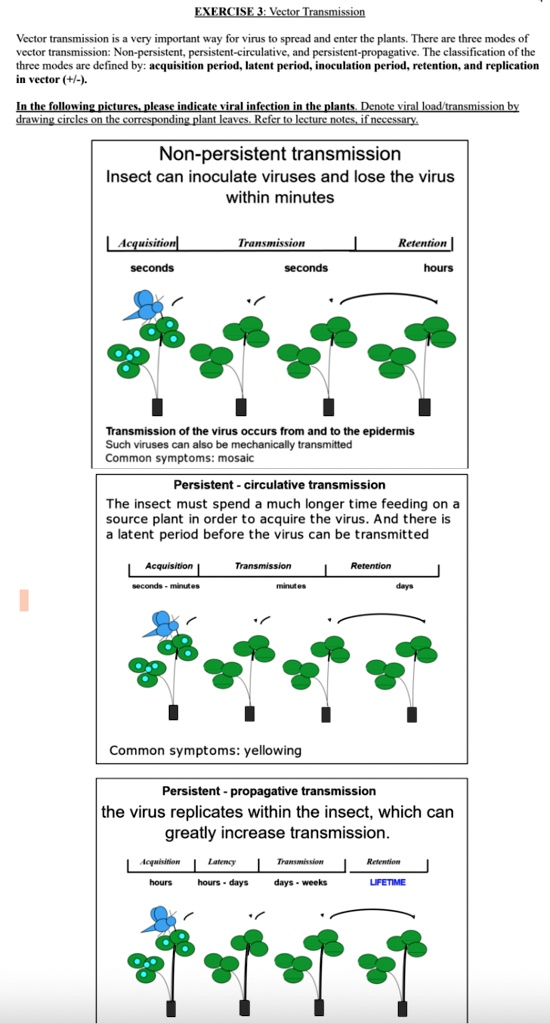
Vector transmission is a very important way for virus to spread and enter the plants. There are three modes of
vector transmission: Non-persistent, persistent-circulative, and persistent-propagative. The classification of the
three modes are defined by: acquisition period, latent period, inoculation period, retention, and replication
in vector (+/-).
In the following pictures, please indicate viral infection in the plants. Denote viral load/transmission by
drawing circles on the corresponding plant leaves. Refer to lecture notes, if necessary.
Non-persistent transmission
Insect can inoculate viruses and lose the virus
within minutes
Acquisition
seconds
Transmission
Retention
seconds
hours
Transmission of the virus occurs from and to the epidermis
Such viruses can also be mechanically transmitted
Common symptoms: mosaic
Persistent - circulative transmission
The insect must spend a much longer time feeding on a
source plant in order to acquire the virus. And there is
a latent period before the virus can be transmitted
Acquisition
seconds-minutes
Transmission
Retention
minutes
days
Common symptoms: yellowing
Persistent - propagative transmission
the virus replicates within the insect, which can
greatly increase transmission.
Acquisition
hours
Latency
Transmission
Retention
hours - days
days - weeks
LIFETIME