Ace - AI Tutor
Ask Our Educators
Textbooks
My Library
Flashcards
Scribe - AI Notes
Notes & Exams
Download App
robert carrillo

robert c.

Divider

Questions asked

BEST MATCH

In the Natural Selection simulation, what are the main factors influencing the evolution of rabbit populations by natural selection? Select all that apply. Check All That Apply Predators targeting rabbits based on fur color. Predators targeting rabbits based on fur color. The availability of different types of food influencing tooth length. The availability of different types of food influencing tooth length. The environment selecting for rabbits with certain ear types. The environment selecting for rabbits with certain ear types. Random mutations occurring in the rabbit population. Random mutations occurring in the rabbit population. Human intervention in the habitat of the rabbits. Human intervention in the habitat of the rabbits.

View Answer
divider
BEST MATCH

9. Overall, emerging adults are about as likely as contemporary senior citizens to work with others on local projects in their communities and raise funds for charitable causes.

View Answer
divider
BEST MATCH

If you put more water than is needed for reaction 3, and then did not dry out this excess water, what effect (if any) would this have on the calculated ratio of oxygen? Select an answer and submit. For keyboard navigation, use the up/down arrow keys to select an answer. a Too low b Too high c Unaffected Unanswered * 1 attempt left Unanswered.1attempt left Unaffected U Too high Too low on the calculated ratio of oxygen? Select an answer and submit. For keyboard navigation, use the up/down arrow keys to select an answer. If you put more water than is needed for reaction 3, and then did not dry out this excess water, what effect (if any) would this have Submit

View Answer
divider
BEST MATCH

3. \( \frac{8 !}{6 !(8-6) !} \)

View Answer
divider
BEST MATCH

A scientist is watching a bug walk back and forth along a line. Suppose the line has a coordinate x, and let p(t) be the continuous function giving the bug's position on the line at time t (in sexonds). The scientist oberves the bug's motions and records what she sces: At t=0, the bug was bocated at x=-0.25. At t=5, the bug passed through the point x=0 for the first and only time. As t->infty , the bug approuches x=0. In other words, lim_(t->infty )p(t)=0. The derivative funtion p^(')(t) - the velocity of the bug - is contimuous. For a few seconds at the beginning p^(')(t) was negative, but then it crossed 0 to become positive at t=3.3. It crossed 0 to become negative again at t=6.7, and remained negative thereafter. Also, p^(')(t) had its maximum value at t=5, and its most negative value at t=2.2 and t=7.8. The bug always stayed within 5 units of x=0. In this problem, you'll figure out how to sloctch a graph of the bug's movements on the interval (0,infty ), even though you don't know the formula for p(t) ! For now, use the information above to answer the following questions. (After you answer them all, you'll get to make the slotch.) (a) Where will the graph of p(t) intersect the t and x axes? (b) Does the graph of p(t) have any asymptotes? If so, where are they? (c) Wbere is p(t) increasing and where is it decressing? (d) What are the t-coordiates of the local minima and maxima? l. A scientist is watching a bug walk back and forth along a line. Suppose the line has a coordinate , and let p(t) be the continuous function giving the bug's position on the line at time t (in seconds) The scientist observes the bug's motions and rexords what she sees: o At t=0,the bug was located at r=-0.25. o At t=5, the bug passed through the point r =0 for the first and only time o As t oc, the bug approaches r = 0. In other words, lim,P(f) = 0. o The derivative funtion p(t) the velocity of the bug is continuous. For a few seconds at the beginning p(f) was negative, but then it crossed 0 to become positive at f = 3.3. It crossed 0 to become negative again at t = 6.7, and remained negative thereafter. o Also, p(f) had its maximum value at = 5, and its most negative value at t = 2.2 and = 7.8. o The bug always stayed within 5 units of r =0. In this problem, you'll figure out how to sketch a graph of the bug's movements on the interval [0, c), even though you dont know the formula for p()! For now, use the information above to answer the following qucstions. (Affer you answer them all, you'll get to make the sketch.) (a) Where will the graph of p(t) intersect the and r axes? (b Does the graph of p(t) have any asymptotes? lf so, where are they? c Where is p increasing and where is it decreasing (d What are the t-coordiates of the local minima and maxima?
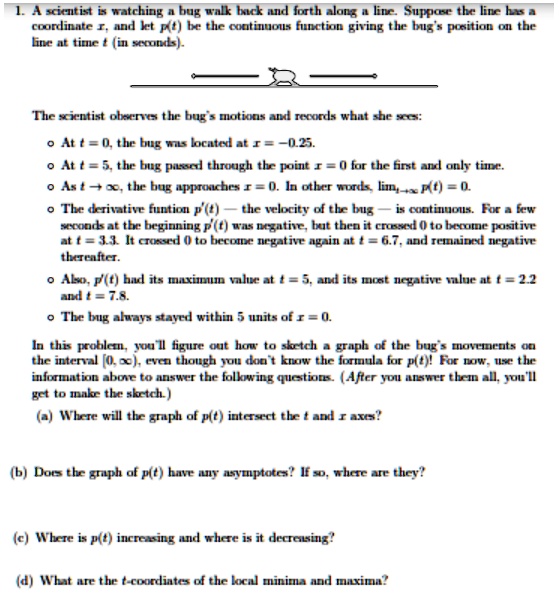
View Answer
divider
BEST MATCH

Hegel's Phenomenology of Spirit can be thought of as a kind of biography of consciousness, the story of its development toward maturity.

View Answer
divider
BEST MATCH

2.5 points If you were to remove all the anthers from a flower, what would that flower no longer be able to do? produce pollen receive pollen from an insect pollinator produce a fruit produce an ovulate cone offer insects a nectar reward

View Answer
divider
BEST MATCH

Find the area inside the oval limaçon $r = 8 + \sin \theta$. The area inside the oval limaçon is (Type an exact answer, using $\pi$ as needed.)

View Answer
divider
BEST MATCH

A contour map for a function $f$ is shown. If you start at the point $(2,5)$ and move in the positive $x$ direction, does the function value increase or decrease? Increases Decreases y 8 40 7 6 30 5 4 20 3 2 10 1 50 5 -4 -3 -2 -1 1 2 3 4

View Answer
divider
BEST MATCH

Perform the following operations. Write your answer in lowest terms. (1)/(3)-(2)/(9)+(5)/(6)

View Answer
divider