Level:
Simulations Task: The 3 Coin Experiment MDM4U
Recall in our lesson about theoretical probability, we used a tree diagram to show all
of the possible outcomes of flipping 3 coins. We then used that diagram to
determine the theoretical probabilities of flipping 0, 1, 2, or 3 heads. I've listed the
probabilities as fractions, I'd like you to get those probabilities as a decimal.
# of heads
O heads
1 head
2 heads
3 heads
Theoretical Probability
(Fraction)
1/8
3/8
3/8
1/8
Theoretical Probability
(Decimal)
One way to verify theoretical probabilities is to perform simulations. Run the experiment many times,
and see if the experimental probabilities match up with the theoretical probabilities.
Also, simulations can be used to estimate probabilities that are difficult to calculate using math (like
using weather simulations to predict the chance of precipitation).
The 3 coins experiment
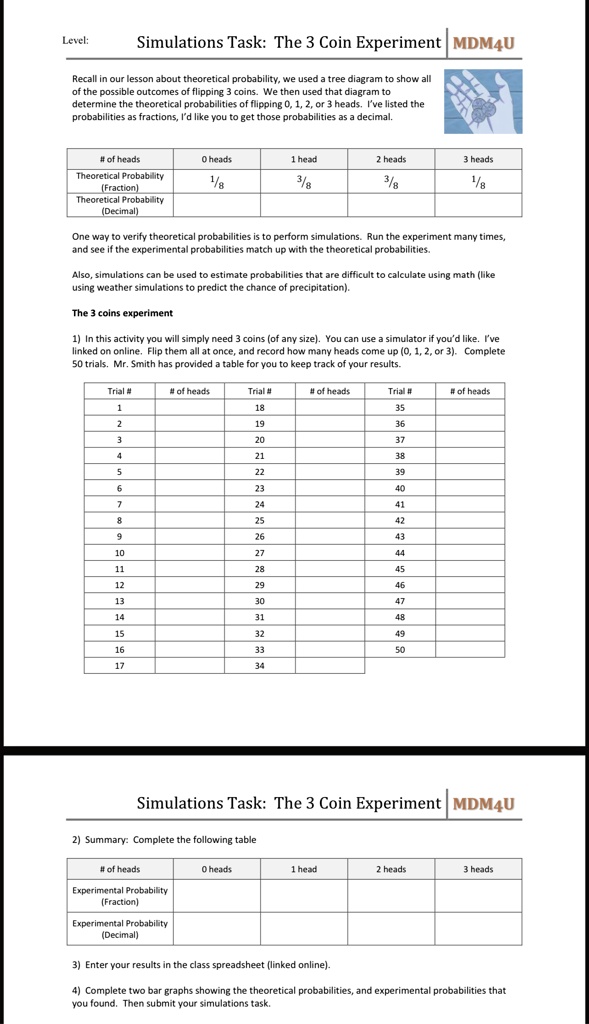
1) In this activity you will simply need 3 coins (of any size). You can use a simulator if you'd like. I've
linked on online. Flip them all at once, and record how many heads come up (0, 1, 2, or 3). Complete
50 trials. Mr. Smith has provided a table for you to keep track of your results.
Trial #
# of heads
Trial #
# of heads
Trial #
# of heads
1
18
35
2
19
36
3
20
37
4
21
38
5
22
39
6
23
40
7
24
41
8
25
42
9
26
43
10
27
44
11
28
45
12
29
46
13
30
47
14
31
48
15
32
49
16
33
50
17
34
Simulations Task: The 3 Coin Experiment MDM4U
2) Summary: Complete the following table
# of heads
Experimental Probability
(Fraction)
Experimental Probability
(Decimal)
0 heads
1 head
2 heads
3 heads
3) Enter your results in the class spreadsheet (linked online).
4) Complete two bar graphs showing the theoretical probabilities, and experimental probabilities that
you found. Then submit your simulations task.