Ace - AI Tutor
Ask Our Educators
Textbooks
My Library
Flashcards
Scribe - AI Notes
Notes & Exams
Download App
robert cuevas

robert c.

Divider

Questions asked

BEST MATCH

Yield rate to maturity for zero coupon bonds are currently quoted at 8.5% for one-year maturity, 9.5% for two-year maturity, and 10.5% for three-year maturity. Let i be the one-year forward rate, deferred one year, implied by current yields of these bonds. Calculate i. A 8.5% B 9.5% C 10.5% D 11.5% E 12.5%

View Answer
divider
BEST MATCH

how is the realizable value of receivables on the balance sheet achieved?

View Answer
divider
BEST MATCH

It is now possible to travel all over the world, especially if you visit major metropolitan areas, without ever having to eat anything but McDonald's food. This is an example of a) counterculture. b) cultural diffusion. c) cultural leveling. d) dominant culture.

View Answer
divider
BEST MATCH

Question 1 In operant conditioning, behavior is a function of its _______________. 1 pts Consequences Unconditioned Stimuli Antecedents Conditioned Stimuli

View Answer
divider
BEST MATCH

The second derivative of a function, f(x), is defined by f^('')(x)=x^(2)(x-2). a) For what values of x is f^('')(x)=0 ? b) Determine the intervals of concavity. c) If f(2)=1, sketch a possible graph of f(x). 13.The second derivative of a function,fx),is defined by f"x)=x2(x-2. a) For what values of x is f"(x)= 0? b) Determine the intervals of concavity. cIf f2)=1,sketch a possible graph of f(x

View Answer
divider
BEST MATCH

What properties does silicon share with carbon that would make silicon-based life more likely than, say, neon-based life or aluminum-based life?

View Answer
divider
BEST MATCH

4) \int_{1}^{4} x^{2} \ln 2 \ dx

View Answer
divider
BEST MATCH

Problem 2. Derive the derivative formulas for each of the six basic trig functions shown below. \frac{d}{dx}(\sin(x)) = \cos(x) \frac{d}{dx}(\cos(x)) = -\sin(x) \frac{d}{dx}(\tan(x)) = \sec^2(x) \frac{d}{dx}(\sec(x)) = \sec(x)\tan(x) \frac{d}{dx}(\csc(x)) = -\csc(x)\cot(x) \frac{d}{dx}(\cot(x)) = -\csc^2(x) You may use the definition of the derivative or any of the derivative rules we derived in class. In addition to this, you may use any of the trig identities in the textbook as well as the results: $\lim_{\theta \to 0} \frac{\sin(\theta)}{\theta} = 1$ $\lim_{\theta \to 0} \frac{\cos(\theta) - 1}{\theta} = 0$ without proof. Any other result you use must be proven in your work. Your work should not have circular logic.

View Answer
divider
BEST MATCH

The book value of a machine after 10 years is $37,000. The machine has a 13 year life. A 125% Declining Balance method is used to determine book value. What was the original Basis (First Cost) of the machine?

View Answer
divider
BEST MATCH

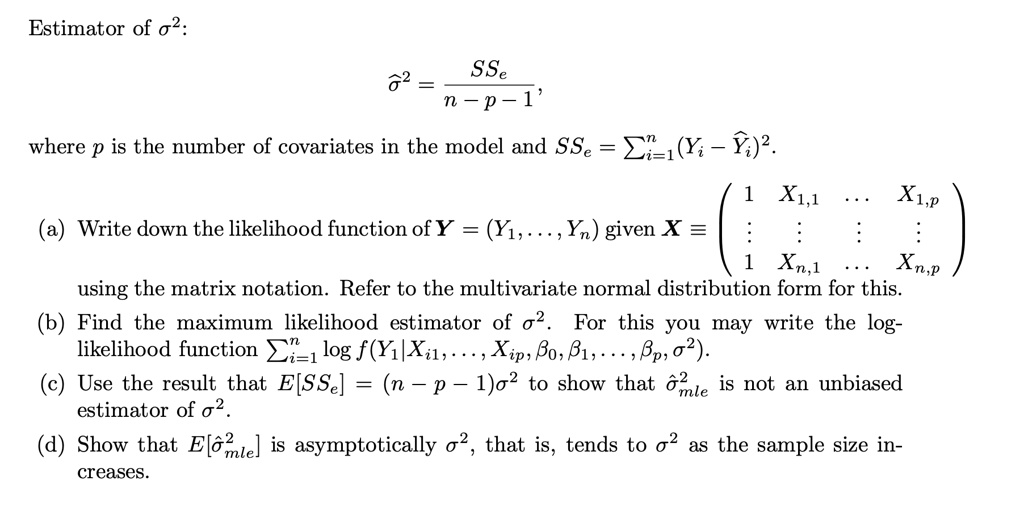
Estimator of $\sigma^2$: \\ $\hat{\sigma}^2 = \frac{SS_e}{n - p - 1}$, \\ where $p$ is the number of covariates in the model and $SS_e = \sum_{i=1}^n (Y_i - \hat{Y}_i)^2$. \\ (a) Write down the likelihood function of $Y = (Y_1, ..., Y_n)$ given $X = \begin{pmatrix} 1 & X_{1,1} & \dots & X_{1,p} \\ \vdots & \vdots & \vdots \\ 1 & X_{n,1} & \dots & X_{n,p} \end{pmatrix}$ \\ using the matrix notation. Refer to the multivariate normal distribution form for this. \\ (b) Find the maximum likelihood estimator of $\sigma^2$. For this you may write the log-likelihood function $\sum_{i=1}^n \log f(Y_i | X_{i1}, ..., X_{ip}, \beta_0, \beta_1, ..., \beta_p, \sigma^2)$. \\ (c) Use the result that $E[SS_e] = (n - p - 1)\sigma^2$ to show that $\hat{\sigma}_{mle}^2$ is not an unbiased estimator of $\sigma^2$. \\ (d) Show that $E[\hat{\sigma}_{mle}^2]$ is asymptotically $\sigma^2$, that is, tends to $\sigma^2$ as the sample size increases.
View Answer
divider