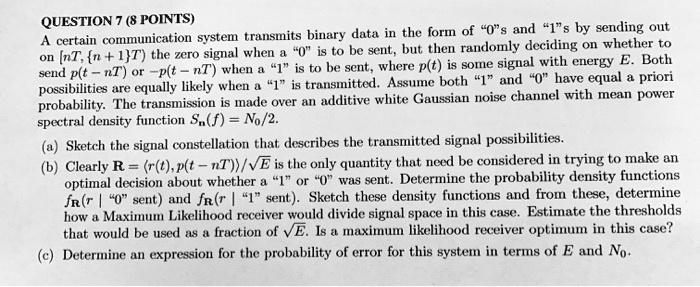
QUESTION 7 (8 POINTS) A certain communication system transmits binary data in the form of 0s and 1s by sending out on [nT, {n+1}T] the zero signal when a 0 is to be sent, but then randomly deciding on whether to send pt - nT or -p(t - nT) when a 1 is to be sent, where pt is some signal with energy E. Both possibilities are equally likely when a 1 is transmitted. Assume both 1 and 0 have equal a priori probability. The transmission is made over an additive white Gaussian noise channel with mean power spectral density function S(nf) = No/2.
a) Sketch the signal constellation that describes the transmitted signal possibilities.
b) Clearly, R = rtp(t - nT)/E is the only quantity that needs to be considered in trying to make an optimal decision about whether a 1 or 0 was sent. Determine the probability density functions f(R|r=0 sent) and f(R|r=1 sent). Sketch these density functions and from these, determine how a Maximum Likelihood receiver would divide signal space in this case. Estimate the thresholds that would be used as a fraction of E. Is a Maximum Likelihood receiver optimum in this case?
c) Determine an expression for the probability of error for this system in terms of E and No.