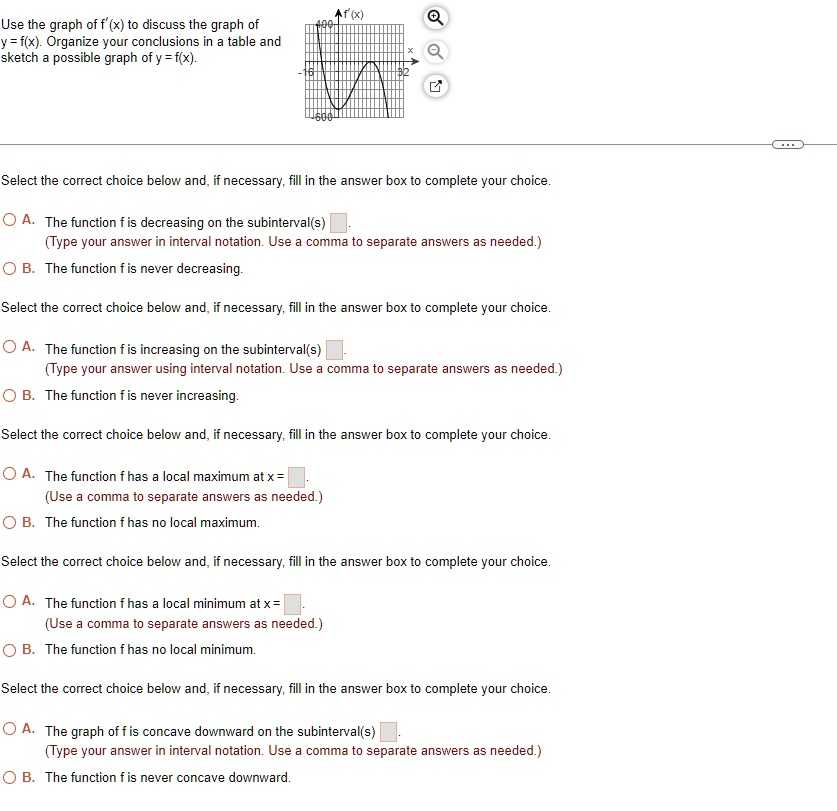
Use the graph of f'(x) to discuss the graph of
y = f(x). Organize your conclusions in a table and
sketch a possible graph of y = f(x).
Af'(x)
400
Q
X
Q
$2
600
Select the correct choice below and, if necessary, fill in the answer box to complete your choice.
A. The function f is decreasing on the subinterval(s)
(Type your answer in interval notation. Use a comma to separate answers as needed.)
B. The function f is never decreasing.
Select the correct choice below and, if necessary, fill in the answer box to complete your choice.
A. The function f is increasing on the subinterval(s)
(Type your answer using interval notation. Use a comma to separate answers as needed.)
B. The function f is never increasing.
Select the correct choice below and, if necessary, fill in the answer box to complete your choice.
A. The function f has a local maximum at x =
(Use a comma to separate answers as needed.)
B. The function f has no local maximum.
Select the correct choice below and, if necessary, fill in the answer box to complete your choice.
A. The function f has a local minimum at x =
(Use a comma to separate answers as needed.)
B. The function f has no local minimum.
Select the correct choice below and, if necessary, fill in the answer box to complete your choice.
A. The graph of f is concave downward on the subinterval(s)
(Type your answer in interval notation. Use a comma to separate answers as needed.)
B. The function f is never concave downward.