Ace - AI Tutor
Ask Our Educators
Textbooks
My Library
Flashcards
Scribe - AI Notes
Notes & Exams
Download App
robert hernandez

robert h.

Divider

Questions asked

BEST MATCH

QUESTION 8 Roughly how much energy in a trophic level is available to the next trophic level? A. 75 percent B. 1 percent C. 50 percent D. 10 percent E. 90 percent QUESTION 9 Most of the carbon in the Earth's atmosphere exists as A. carbonic acid, H2CO3. B. carbon dioxide, CO2. C. chlorofluorocarbons, CFCs. D. carbon tetrachloride, CCl4. E. methane, CH4. QUESTION 10 The "fundamental niche" of an organism is defined as the A. range of environmental conditions under which the organism can survive and reproduce. B. area in which the organism reproduces. C. climatic conditions required for the organism to survive and reproduce. D. physical space that the organism occupies. E. area that an organism occupies immediately after birth.

View Answer
divider
BEST MATCH

What structure holds the lens in place? Multiple Choice Iris Scleral venous sinus Choroid

View Answer
divider
BEST MATCH

While in office the president receives O a salary of $400, 000. O $50, 000 for expenses. O free medical treatment. O all of the above.

View Answer
divider
BEST MATCH

When planning independent activities to enhance preschoolers’ literacy development Group of answer choices require each child to participate in each center provide centers where children can explore using written language in meaningful ways provide penmanship workbooks in the writing center set up a center for children to write words that rhyme in their journals

View Answer
divider
BEST MATCH

suppose a team of scientists is studying the formation of an island chain

View Answer
divider
BEST MATCH

The state of __________, also known as the Zone, is referred to as the seemingly elusive experience in which all things “click” and the person is free to respond at the highest level. Question 40Answer a. "no-mind" b. "fight or flight" c. euphoria d. settling-in, here

View Answer
divider
BEST MATCH

(a) Determine the expression of the discrete-time harmonically related complex exponential (HRCE) signal family for a given fundamental frequency \(\omega = \frac{2\pi}{5}\). How many distinct DT HRCEs are in this family? What is the common period of all HRCEs in this family? Expression for DT HRCE: Number of distinct DT HRCEs: Common Period of DT HRCEs: (b) Show that for the DT HRCE family with parameter N, \(Re\{x_k[n] \} = Re\{x_{N-k}[n] \)\nand\(Im\{x_k[n] \} = -Im\{x_{N-k}[n] \} when N is an even integer and \(0 < k < N/2\).

View Answer
divider
BEST MATCH

b. Suppose that $E_2 \begin{bmatrix} -5 & 1 \\ 2 & 1 \end{bmatrix} = \begin{bmatrix} 2 & 1 \\ -5 & 1 \end{bmatrix}$. Find $E_2$ and $E_2^{-1}$. $E_2 = \begin{bmatrix} \\ \\ \\ \end{bmatrix}$, $E_2^{-1} = \begin{bmatrix} \\ \\ \end{bmatrix}$ c. Suppose that $E_3 \begin{bmatrix} -5 & 1 \\ 2 & 1 \end{bmatrix} = \begin{bmatrix} 7 & 7 \\ 2 & 1 \end{bmatrix}$. Find $E_3$ and $E_3^{-1}$. $E_3 = \begin{bmatrix} \\ \\ \end{bmatrix}$, $E_3^{-1} = \begin{bmatrix} \\ \\ \end{bmatrix}$ d. Suppose that $E_4 \begin{bmatrix} -5 & 1 & -2 \\ -2 & 5 & -5 \\ -4 & -3 & 2 \end{bmatrix} = \begin{bmatrix} -5 & 1 & -2 \\ -10 & 25 & -25 \\ -4 & -3 & 2 \end{bmatrix}$. Find $E_4$ and $E_4^{-1}$. $E_4 = \begin{bmatrix} \\ \\ \\ \\ \end{bmatrix}$, $E_4^{-1} = \begin{bmatrix} \\ \\ \\ \\ \end{bmatrix}$

View Answer
divider
BEST MATCH

b) For the car cruise control, the momentum loss due to air resistance and rolling is proportional to the velocity of the car as shown in the figure below, where u is the force of the engine and b is the resistance coefficient. u m bv Obtain the differential equation of the cruise control model and use the Laplace transform technique to determine the velocity of the car at any time interval. Assume that: m = 1000 kg b = 50 N.sec/m u = 500 N [10 marks]

View Answer
divider
BEST MATCH

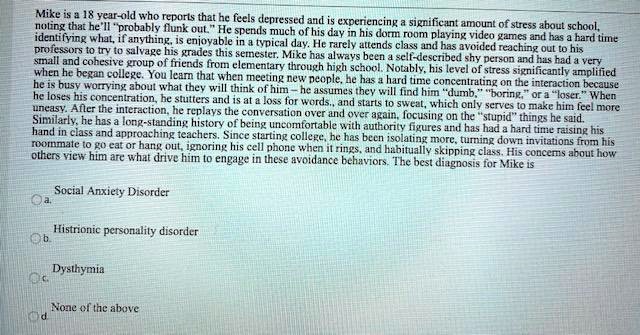
Mike is a 18 year-old who reports that he feels depressed and is experiencing a significant amount of stress about school, noting that he'll "probably flunk out." He spends much of his day in his dorm room playing video games and has a hard time identifying what, if anything, is enjoyable in a typical day. He rarely attends class and has avoided reaching out to his professors to try to salvage his grades this semester. Mike has always been a self-described shy person and has had a very small and cohesive group of friends from elementary through high school. Notably, his level of stress significantly amplified when he began college. You learn that when meeting new people, he has a hard time concentrating on the interaction because he is busy worrying about what they will think of him -- he assumes they will find him "dumb," "boring," or a "loser." When he loses his concentration, he stutters and is at a loss for words., and starts to sweat, which only serves to make him feel more uneasy. After the interaction, he replays the conversation over and over again, focusing on the "stupid" things he said. Similarly, he has a long-standing history of being uncomfortable with authority figures and has had a hard time raising his hand in class and approaching teachers. Since starting college, he has been isolating more, turning down invitations from his roommate to go eat or hang out, ignoring his cell phone when it rings, and habitually skipping class. His concerns about how others view him are what drive him to engage in these avoidance behaviors. The best diagnosis for Mike is Social Anxiety Disorder Oa. Histrionic personality disorder Ob Dysthymia Oc None of the above od
View Answer
divider