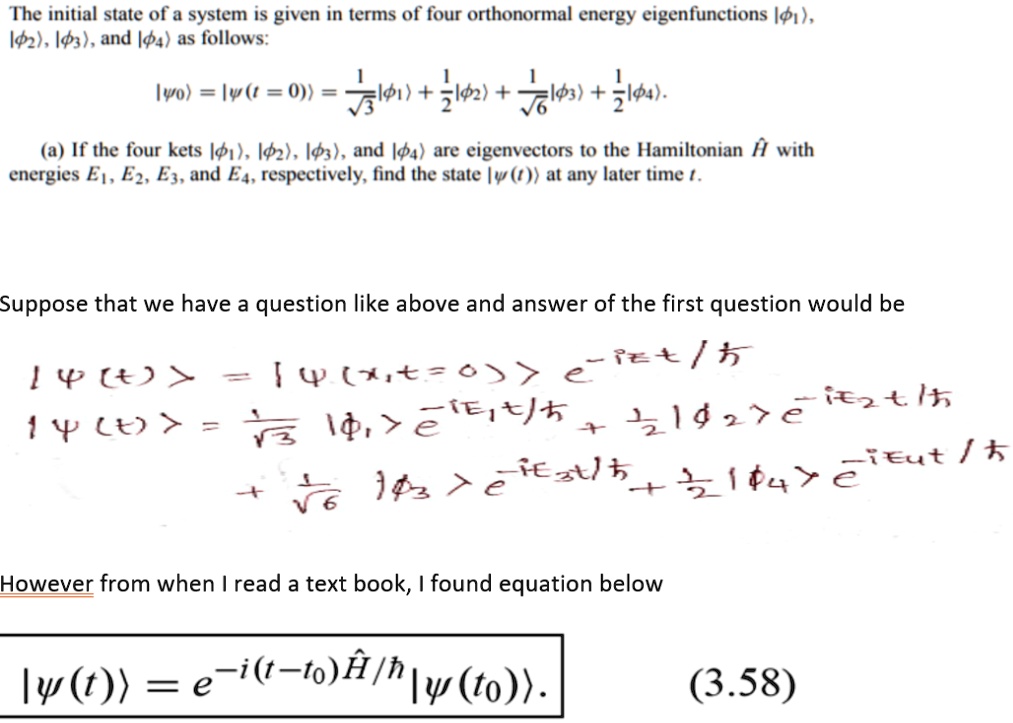
The initial state of a system is given in terms of four orthonormal energy eigenfunctions $|\phi_1\rangle$, $|\phi_2\rangle$, $|\phi_3\rangle$, and $|\phi_4\rangle$ as follows:
$\psi(0)\rangle = |\psi(t=0)\rangle = \frac{1}{\sqrt{3}}|\phi_1\rangle + \frac{1}{2}|\phi_2\rangle + \frac{1}{\sqrt{6}}|\phi_3\rangle + \frac{1}{2}|\phi_4\rangle$.
(a) If the four kets $|\phi_1\rangle$, $|\phi_2\rangle$, $|\phi_3\rangle$, and $|\phi_4\rangle$ are eigenvectors to the Hamiltonian $\hat{H}$ with energies $E_1$, $E_2$, $E_3$, and $E_4$, respectively, find the state $|\psi(t)\rangle$ at any later time $t$.
Suppose that we have a question like above and answer of the first question would be
$|\psi(t)\rangle = |\psi(t=0)\rangle e^{-iE_1t/\hbar}$
$|\psi(t)\rangle = \frac{1}{\sqrt{3}}|\phi_1\rangle e^{-iE_1t/\hbar} + \frac{1}{2}|\phi_2\rangle e^{-iE_2t/\hbar} + \frac{1}{\sqrt{6}}|\phi_3\rangle e^{-iE_3t/\hbar} + \frac{1}{2}|\phi_4\rangle e^{-iE_4t/\hbar}$
However from when I read a text book, I found equation below
$|\psi(t)\rangle = e^{-i(t-t_0)\hat{H}/\hbar}|\psi(t_0)\rangle$.
(3.58)