Historically, the course covering material and energy balances at many universities is challenging. Many students, however, are
resilient.
The historical data for Professor Testor's classes indicate that about 60% of the students (new students plus students who are
retaking the course) pass the class.
Of the students who do not pass, 75% register to take the class again the following semester.
Round your answers to the following questions to the nearest Integer.
If 100 new students (students that have never taken the class before) register for the class each semester, what is the total number
of students taking the class?
students
II 100 new students (students that have never taken the class before) register for the class each semester, what is the total number
of students that drop out of the curriculum after each semester?
students
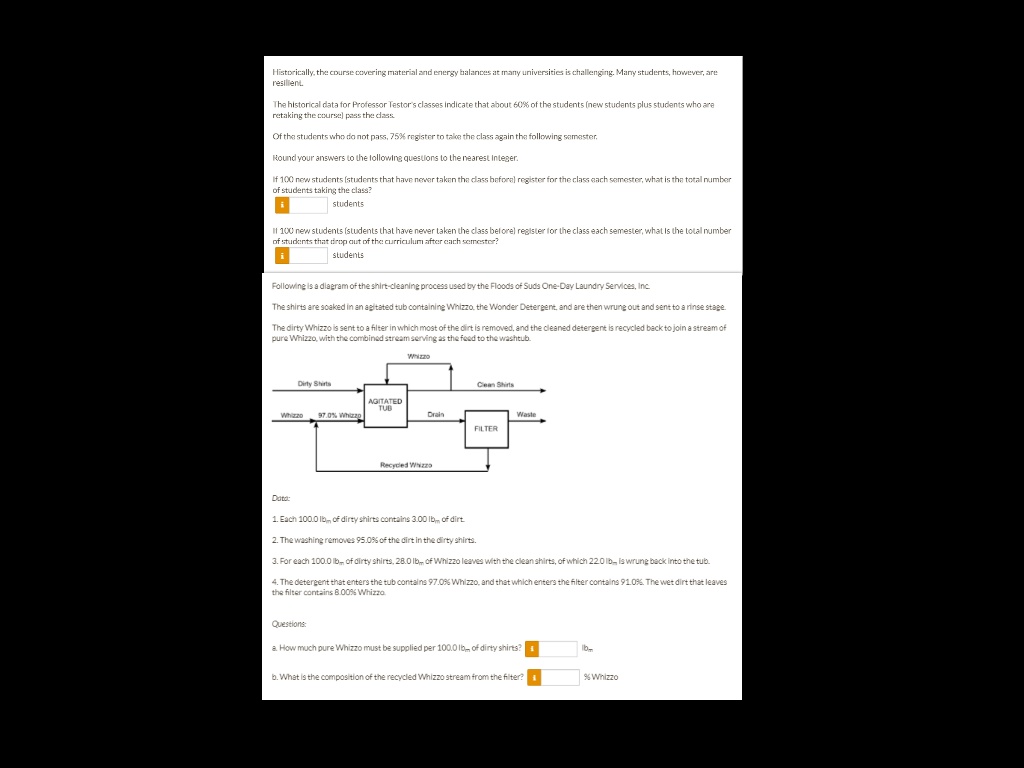
Following is a diagram of the shirt-cleaning process used by the Floods of Suds One-Day Laundry Services, Inc.
The shirts are soaked in an agitated tub containing Whizzo, the Wonder Detergent, and are then wrung out and sent to a rinse stage.
The dirty dirty Whizzo is sent to a filter in which most of the e dirt is removed, and the cleaned detergent is recycled back to join a stream of
pure Whizzo, with the combined stream serving as the feed to the washtub.
Dirty Shirts
Whizzo
Clean Shirts
AGITATED
Whizzo 97.0% Whizzp
Drain
FILTER
Data:
Recycled Whizzo
1. Each 100.0 lbm of dirty shirts contains 3.00 lbm of dirt.
2. The washing removes 95.0% of the dirt in the dirty shirts.
3. For each 100.0 lbm of dirty shirts, 28.0 lbm of Whizzo leaves with the clean shirts, of which 22.0 lbm is wrung back into the tub.
4. The detergent that enters the tub contains 97.0% Whizzo, and that which enters the filter contains 91.0%. The wet dirt that leaves
the filter contains 8.00% Whizzo.
Questions:
a. How much pure Whizzo must be supplied per 100.0 lbm of dirty shirts?
b. What is the composition of the recycled Whizzo stream from the filter?
% Whizzo