Ace - AI Tutor
Ask Our Educators
Textbooks
My Library
Flashcards
Scribe - AI Notes
Notes & Exams
Download App
Robert Newbold

Robert N.

Divider

Viewed Questions

Angle between Two Lines Let $L_{1}$ and $L_{2}$ denote two nonvertical intersecting lines, and let $\theta$ denote the acute angle between $L_{1}$ and $L_{2}$ (see the figure). Show that
$$
\tan \theta=\frac{m_{2}-m_{1}}{1+m_{1} m_{2}}
$$
where $m_{1}$ and $m_{2}$ are the slopes of $L_{1}$ and $L_{2},$ respectively. [Hint: Use the facts that $\left.\tan \theta_{1}=m_{1} \text { and } \tan \theta_{2}=m_{2} .\right]$

Angle between Two Lines Let $L_{1}$ and $L_{2}$ denote two nonvertical intersecting lines, and let $\theta$ denote the acute angle between $L_{1}$ and $L_{2}$ (see the figure). Show that $$ \tan \theta=\frac{m_{2}-m_{1}}{1+m_{1} m_{2}} $$ where $m_{1}$ and $m_{2}$ are the slopes of $L_{1}$ and $L_{2},$ respectively. [Hint: Use the facts that $\left.\tan \theta_{1}=m_{1} \text { and } \tan \theta_{2}=m_{2} .\right]$

Algebra and Trigonometry

Analytic Trigonometry

Sum and Difference Formulas

 Let $\ell_{1}$ and $\ell_{2}$ be two nonvertical intersecting lines with slopes $m_{1}$ and $m_{2}$, respectively. If $\theta$, the angle from $\ell_{1}$ to $\ell_{2}$, is not a right angle, then
$$
\tan \theta=\frac{m_{2}-m_{1}}{1+m_{1} m_{2}}
$$

Let $\ell_{1}$ and $\ell_{2}$ be two nonvertical intersecting lines with slopes $m_{1}$ and $m_{2}$, respectively. If $\theta$, the angle from $\ell_{1}$ to $\ell_{2}$, is not a right angle, then $$ \tan \theta=\frac{m_{2}-m_{1}}{1+m_{1} m_{2}} $$

Calculus Early Transcendentals: Pearson New International Edition

Preliminaries

The Trigonometric Functions

A tunnel is dug through the center of a perfectly spherical and airless planet of radius $R$. Using the expression for $g$ derived in Gravitation Near Earth's Surface for a uniform density, show that a particle of mass $m$ dropped in the tunnel will execute simple harmonic motion. Deduce the period of oscillation of $m$ and show that it has the same period as an orbit at the surface.

A tunnel is dug through the center of a perfectly spherical and airless planet of radius $R$. Using the expression for $g$ derived in Gravitation Near Earth's Surface for a uniform density, show that a particle of mass $m$ dropped in the tunnel will execute simple harmonic motion. Deduce the period of oscillation of $m$ and show that it has the same period as an orbit at the surface.

University Physics Volume 1

We know from Table 1 that similar matrices have the same rank. Show that the converse is false by showing that the matrices
$$A=\left[\begin{array}{ll}1 & 0 \\0 & 0\end{array}\right] \quad \text { and } \quad B=\left[\begin{array}{ll}0 & 1 \\0 & 0\end{array}\right]$$
have the same rank but are not similar. [Suggestion: If they were similar, then there would be an invertible $2 \times 2$ matrix $P$ for which $A P=P B .$ Show that there is no such matrix.]

We know from Table 1 that similar matrices have the same rank. Show that the converse is false by showing that the matrices $$A=\left[\begin{array}{ll}1 & 0 \\0 & 0\end{array}\right] \quad \text { and } \quad B=\left[\begin{array}{ll}0 & 1 \\0 & 0\end{array}\right]$$ have the same rank but are not similar. [Suggestion: If they were similar, then there would be an invertible $2 \times 2$ matrix $P$ for which $A P=P B .$ Show that there is no such matrix.]

Elementary Linear Algebra: Applications Version

Eigenvalues and Eigenvectors

Diagonalization

Questions asked

ANSWERED

Israel Hernandez verified

Numerade educator

S: z=x^2 +2y^2, find vector function that represents elliptic paraboloid

View Answer
divider
ANSWERED

Israel Hernandez verified

Numerade educator

Find a vector function that represents the elliptic paraboloid z=x^{2}+2y^{2}

View Answer
divider
INSTANT ANSWER

4. An air wedge is formed between two flat pieces of glass (each \( 10 \mathrm{~cm} \) long and \( 1 \mathrm{~cm} \) thick) by placing a piece of tissue paper between them as shown below. It is illuminated by a sodium lamp (whose emission is dominated by light with wavelength \( \sim 0.589 \mu \mathrm{m} \) and has a coherence time of \( 2 \times 10^{-12} \) sec.) a) Consider interference between the ray reflected from the glass-air boundary at the top of the air wedge with the ray from the air-glass boundary at the bottom of the air wedge. State the conditions relating the thickness of the film and the wavelength for (i) constructive interference, and (ii) destructive interference. [The wedge angle is very small and so it is reasonable to assume that the wavefronts reflected from the upper and lower surfaces of the air wedge are parallel.] b) If 87 straight parallel fringes are visible over the \( 4 \mathrm{~cm} \) region illustrated in the image above, deduce the thickness of the tissue paper. c) Explain why rays reflected from the upper surface of the upper glass plate and from the lower surface of the lower plate do not contribute to the observed interference pattern.

View Answer
divider
INSTANT ANSWER

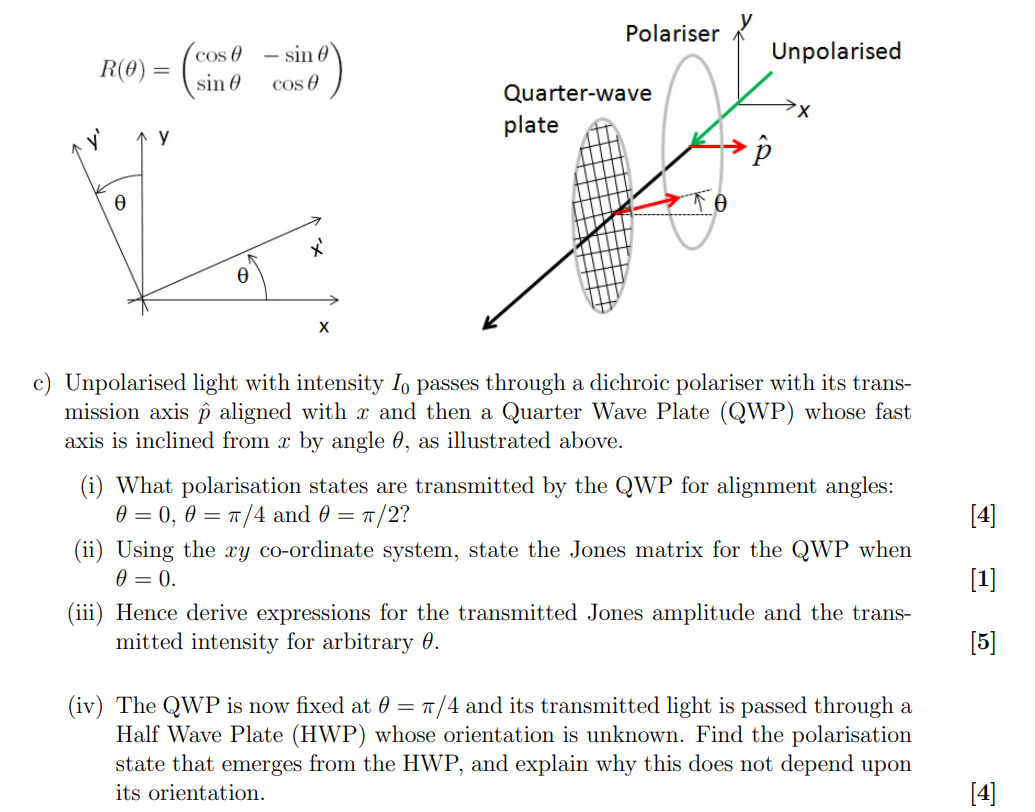
c) Unpolarised light with intensity \( I_{0} \) passes through a dichroic polariser with its transmission axis \( \hat{p} \) aligned with \( x \) and then a Quarter Wave Plate (QWP) whose fast axis is inclined from \( x \) by angle \( \theta \), as illustrated above. (i) What polarisation states are transmitted by the QWP for alignment angles: \( \theta=0, \theta=\pi / 4 \) and \( \theta=\pi / 2 \) ? (ii) Using the \( x y \) co-ordinate system, state the Jones matrix for the QWP when \( \theta=0 \). [1] (iii) Hence derive expressions for the transmitted Jones amplitude and the transmitted intensity for arbitrary \( \theta \). (iv) The QWP is now fixed at \( \theta=\pi / 4 \) and its transmitted light is passed through a Half Wave Plate (HWP) whose orientation is unknown. Find the polarisation state that emerges from the HWP, and explain why this does not depend upon its orientation. \( [4] \)
View Answer
divider
INSTANT ANSWER

b) The right circular polarisation state can be represented by \( \mathcal{R}=\frac{1}{\sqrt{2}}\left(\begin{array}{c}1 \\ -i\end{array}\right) \) in an \( x y \) Cartesian system. Find \( \mathcal{R}^{\prime} \), the Jones vector of this state expressed in the \( x^{\prime} y^{\prime} \) frame which is rotated anti-clockwise from \( x y \) by angle \( \theta \), as illustrated below left. You should express your answers in terms of \( \mathcal{R} \). [3] [ Hint: You will find it useful to recall that the matrix \( R(\theta) \) converts a vector whose components are expressed in the \( x^{\prime} y^{\prime} \) frame to the \( x y \) representation.]

View Answer
divider
ANSWERED

Amit Srivastava verified

Numerade educator

a) An electromagnetic plane wave travelling through free space in the z direction has components of E and B which each have the general form f(kz ? ?t). (i) Use Gauss's Law to show that E is transverse. (ii) For the case E = E0ex sin(kz ? ?t) use the Maxwell-Faraday equation to find B, and hence show that B is also transverse, perpendicular to E and with magnitude B = E/c. Find the Poynting vector and the intensity of the wave.

View Answer
divider
ANSWERED

Adriano Chikande verified

Numerade educator

The specific Helmholtz free energy of a particular gas is [ f=c T^{2}-frac{a}{v}-R T ln (v-b) ] where ( a, b ) and ( c ) are constants. Calculate the pressure of the gas in terms of ( T ) and ( v ).

View Answer
divider
ANSWERED

Amit Srivastava verified

Numerade educator

Consider a system in contact with a heat bath at temperature T that can exchange energy but not particles with its surroundings. The energy of its microstates is given by ?n = nkBT, where n = 0, 1, ... enumerates microstates, and kB is the Boltzmann constant. Calculate the free energy of the system.

View Answer
divider
ANSWERED

Federico Castro verified

Numerade educator

A particle's position is specified by a random variable x that lies in the range 0 ? x < ?. The probability that it is found in the range [x, x + dx] is given by p(x)dx where p(x) = ?e??x and ? > 0 is a constant. (a) Show that the distribution p(x) is correctly normalised. (b) Determine the mean position of the particle.

View Answer
divider
INSTANT ANSWER

This question concerns a system of interest in the grand canonical ensemble where the temperature is \( T \) and the chemical potential is \( \mu \). (a) Draw a diagram that illustrates the physical setup of the grand canonical ensemble, noting which quantities can fluctuate in the system of interest. [3] (b) Under the assumption that the system of interest comprises weakly-interacting bosons, state the mean number of particles that occupy a non-degenerate quantum state with energy \( \epsilon \). \( [2] \)

View Answer
divider