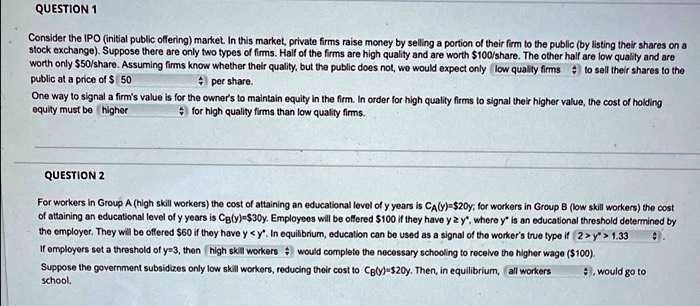
QUESTION 1
Consider the IPO (initial public offering) market. In this market, private firms raise money by selling a portion of their firm to the public (by listing their shares on a
stock exchange). Suppose there are only two types of firms. Half of the firms are high quality and are worth $100/share. The other half are low quality and are
worth only $50/share. Assuming firms know whether their quality, but the public does not, we would expect only low quality firms to sell their shares to the
public at a price of $ 50 per share.
One way to signal a firm's value is for the owner's to maintain equity in the firm. In order for high quality firms to signal their higher value, the cost of holding
equity must be higher for high quality firms than low quality firms.
QUESTION 2
For workers in Group A (high skill workers) the cost of attaining an educational level of y years is $C_A(y) = \$20y$; for workers in Group B (low skill workers) the cost
of attaining an educational level of y years is $C_B(y) = \$30y$. Employees will be offered $100 if they have $y \ge y^*$, where $y^*$ is an educational threshold determined by
the employer. They will be offered $60 if they have $y < y^*$. In equilibrium, education can be used as a signal of the worker's true type if $2 > y^* > 1.33$
If employers set a threshold of y=3, then high skill workers would complete the necessary schooling to receive the higher wage ($100).
Suppose the government subsidizes only low skill workers, reducing their cost to $C_B(y) = \$20y$. Then, in equilibrium, all workers would go to
school.