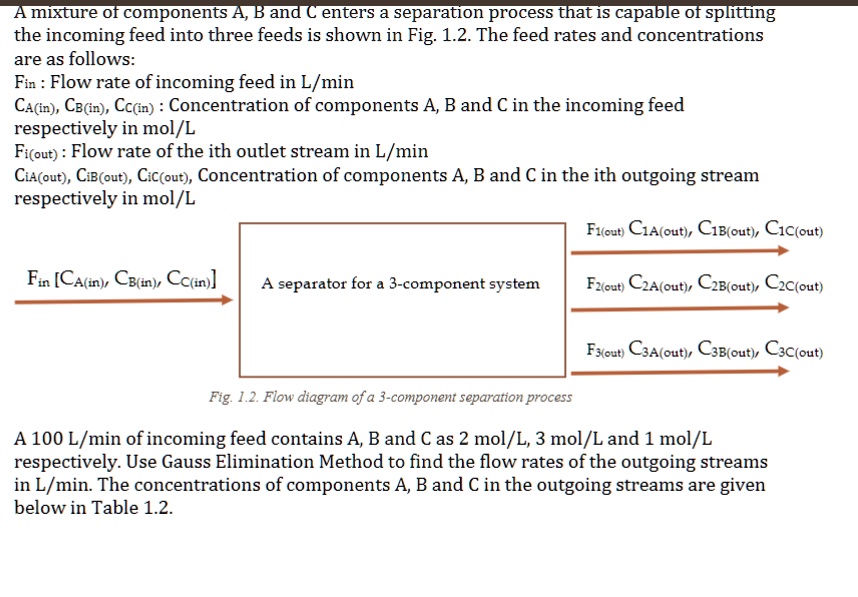
A mixture of components A, B and C enters a separation process that is capable of splitting the incoming feed into three feeds is shown in Fig. 1.2. The feed rates and concentrations are as follows:
Fin: Flow rate of incoming feed in L/min
CA(in), CB(in), CC(in): Concentration of components A, B and C in the incoming feed respectively in mol/L
Fi(out): Flow rate of the ith outlet stream in L/min
CiA(out), CiB(out), CiC(out), Concentration of components A, B and C in the ith outgoing stream respectively in mol/L
F1(out) C1A(out), C1B(out), C1C(out)
Fin [CA(in), CB(in), CC(in)]
A separator for a 3-component system
F2(out) C2A(out), C2B(out), C2C(out)
F3(out) C3A(out), C3B(out), C3C(out)
Fig. 1.2. Flow diagram of a 3-component separation process
A 100 L/min of incoming feed contains A, B and C as 2 mol/L, 3 mol/L and 1 mol/L respectively. Use Gauss Elimination Method to find the flow rates of the outgoing streams in L/min. The concentrations of components A, B and C in the outgoing streams are given below in Table 1.2.