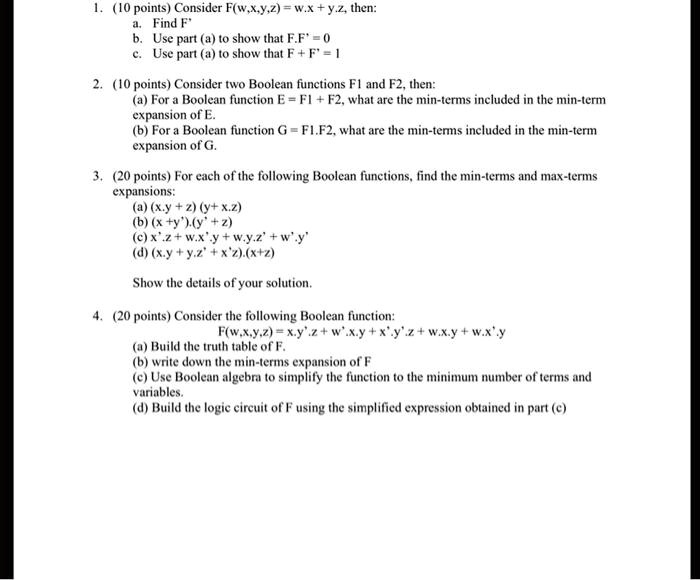
1. (10 points) Consider F(w,x,y,z) = w.x + y.z, then:
a. Find F
b. Use part (a) to show that F.F' = 0
c. Use part (a) to show that F+F'=1
2. (10 points) Consider two Boolean functions F1 and F2, then:
(a) For a Boolean function E = F1 + F2, what are the min-terms included in the min-term
expansion of E.
(b) For a Boolean function G = F1.F2, what are the min-terms included in the min-term
expansion of G.
3. (20 points) For each of the following Boolean functions, find the min-terms and max-terms
expansions:
(a) (x.y + z) (y+x.z)
(b) (x+y').(y+z)
(c) x'.z+w.x.y + w.y.z' + w'.y'
(d) (x.y + y.z' + x'z).(x+z)
Show the details of your solution.
4. (20 points) Consider the following Boolean function:
F(w,x,y,z)= x.y'.z+ w'.x.y + x'.y'.z+ w.x.y + w.x'.y
(a) Build the truth table of F.
(b) write down the min-terms expansion of F
(c) Use Boolean algebra to simplify the function to the minimum number of terms and
variables.
(d) Build the logic circuit of F using the simplified expression obtained in part (c)