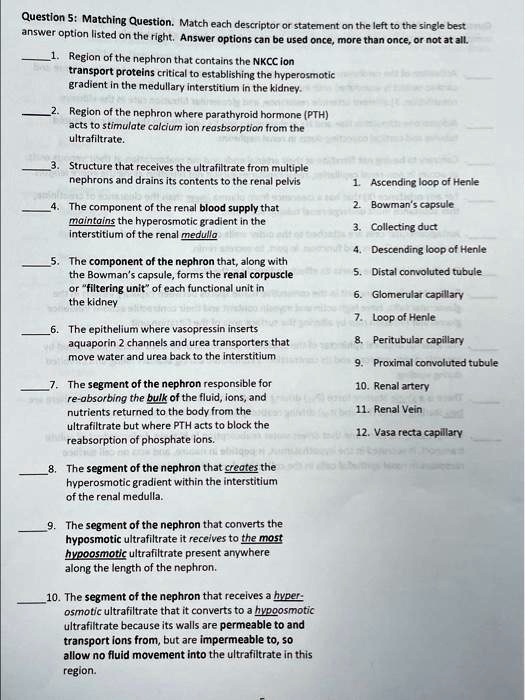
Region of the nephron that contains the NKCC ion transport proteins critical to establishing the hyperosmotic gradient in the medullary interstitium in the kidney. Region of the nephron where parathyroid hormone (PTH) acts to stimulate calcium ion reabsorption from the ultrafiltrate.
Structure that receives the ultrafiltrate from multiple nephrons and drains its contents to the renal pelvis
1. Ascending loop of Henle
The component of the renal blood supply that maintains the hyperosmotic gradient in the interstitium of the renal medulla
2. Bowman's capsule
3. Collecting duct
4. Descending loop of Henle
The component of the nephron that, along with the Bowman's capsule, forms the renal corpuscle or "filtering unit" of each functional unit in the kidney
5. Distal convoluted tubule
6. Glomerular capillary
7. Loop of Henle
6. The epithelium where vasopressin inserts aquaporin 2 channels and urea transporters that move water and urea back to the interstitium
8. Peritubular capillary
9. Proximal convoluted tubule
7. The segment of the nephron responsible for re-absorbing the bulk of the fluid, ions, and nutrients returned to the body from the ultrafiltrate but where PTH acts to block the reabsorption of phosphate ions.
10. Renal artery
11. Renal Vein
12. Vasa recta capillary
8. The segment of the nephron that creates the hyperosmotic gradient within the interstitium of the renal medulla.
The segment of the nephron that converts the hyposmotic ultrafiltrate it receives to the most hypoosmotic ultrafiltrate present anywhere along the length of the nephron.
10. The segment of the nephron that receives a hyperosmotic ultrafiltrate that it converts to a hypoosmotic ultrafiltrate because its walls are permeable to and transport ions from, but are impermeable to, so allow no fluid movement into the ultrafiltrate in this region.