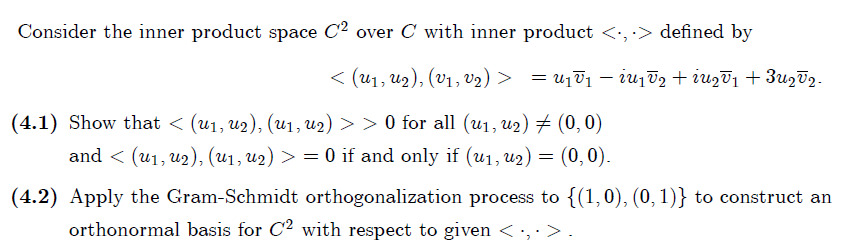
Consider the inner product space \( C^{2} \) over \( C \) with inner product \( <\cdot, \cdot> \) defined by
\[
<\left(u_{1}, u_{2}\right),\left(v_{1}, v_{2}\right)>=u_{1} \bar{v}_{1}-i u_{1} \bar{v}_{2}+i u_{2} \bar{v}_{1}+3 u_{2} \bar{v}_{2}
\]
(4.1) Show that \( <\left(u_{1}, u_{2}\right),\left(u_{1}, u_{2}\right)>>0 \) for all \( \left(u_{1}, u_{2}\right) \neq(0,0) \) and \( <\left(u_{1}, u_{2}\right),\left(u_{1}, u_{2}\right)>=0 \) if and only if \( \left(u_{1}, u_{2}\right)=(0,0) \).
(4.2) Apply the Gram-Schmidt orthogonalization process to \( \{(1,0),(0,1)\} \) to construct an orthonormal basis for \( C^{2} \) with respect to given \( \langle\cdot, \cdot\rangle \).