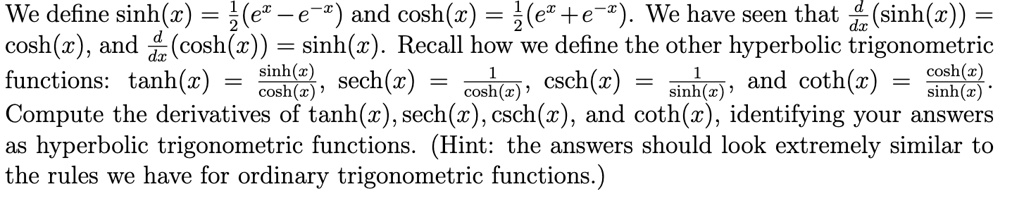
We define $\sinh(x) = \frac{1}{2}(e^x - e^{-x})$ and $\cosh(x) = \frac{1}{2}(e^x + e^{-x})$. We have seen that $\frac{d}{dx}(\sinh(x)) = \cosh(x)$, and $\frac{d}{dx}(\cosh(x)) = \sinh(x)$. Recall how we define the other hyperbolic trigonometric functions: $\tanh(x) = \frac{\sinh(x)}{\cosh(x)}$, $\sech(x) = \frac{1}{\cosh(x)}$, $\csch(x) = \frac{1}{\sinh(x)}$, and $\coth(x) = \frac{\cosh(x)}{\sinh(x)}$. Compute the derivatives of $\tanh(x)$, $\sech(x)$, $\csch(x)$, and $\coth(x)$, identifying your answers as hyperbolic trigonometric functions. (Hint: the answers should look extremely similar to the rules we have for ordinary trigonometric functions.)