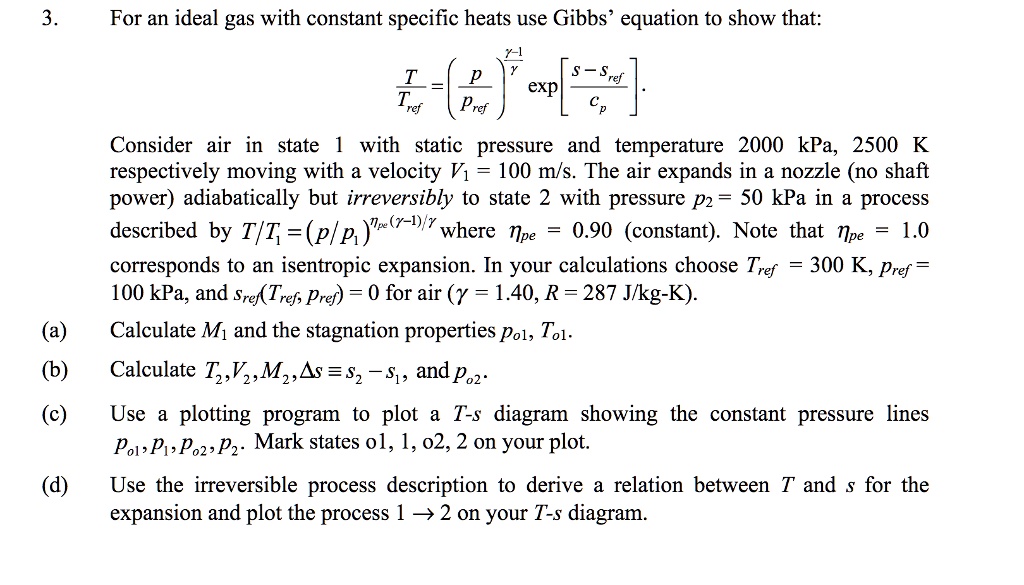
For an ideal gas with constant specific heats, use Gibbs' equation to show that:
Consider air in state 1 with static pressure and temperature of 2000 kPa and 2500 K, respectively, moving with a velocity Vi = 100 m/s. The air expands in a nozzle (no shaft power) adiabatically but irreversibly to state 2 with a pressure p2 = 50 kPa in a process that corresponds to an isentropic expansion. In your calculations, choose Tref = 300 K, Pref = 100 kPa, and sre(Tref, Pref) = 0 for air (y = 1.40, R = 287 J/kg-K). Calculate Mi and the stagnation properties pol, To1.
(a) (b)
Calculate T2, V2, M2, s2 - s1, and p2.
(c)
Use a plotting program to plot a T-s diagram showing the constant pressure lines P1, P2. Mark states 01, 1, 02, 2 on your plot. Use the irreversible process description to derive a relation between T and s for the expansion and plot the process 1 -> 2 on your T-s diagram.
(d)