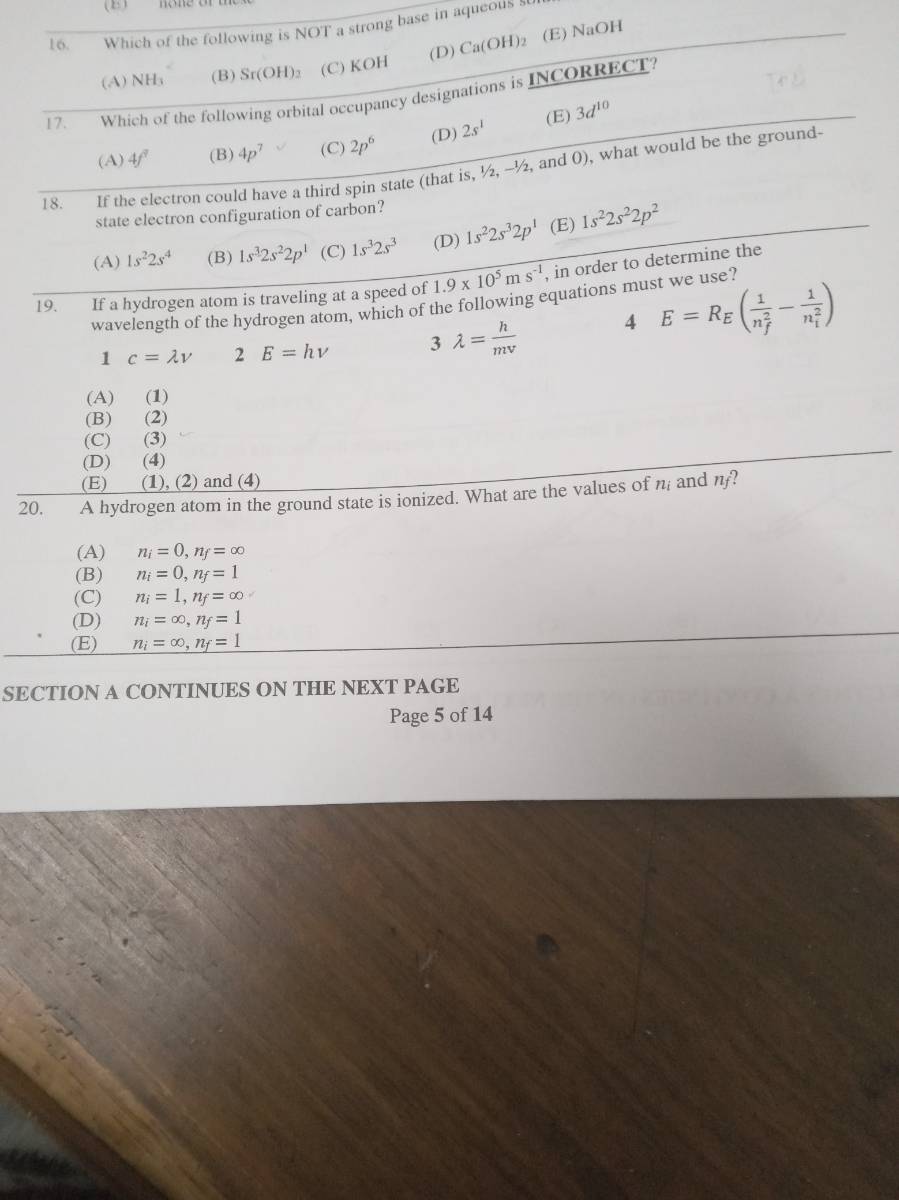
16. Which of the following is NOT a strong base in aqueous striat
(A) \( \mathrm{NH}_{3} \)
(B) \( \mathrm{Sr}(\mathrm{OH})_{2} \)
(C) \( \mathrm{KOH} \)
(D) \( \mathrm{Ca}(\mathrm{OH})_{2} \)
(E) \( \mathrm{NaOH} \)
17. Which of the following orbital occupancy designations is INCORRECT?
(A) \( 4 f^{\prime} \)
(B) \( 4 p^{7} \)
(C) \( 2 p^{6} \)
(D) \( 2 s^{1} \)
(E) \( 3 d^{10} \)
18. If the electron could have a third spin state (that is, \( 1 / 2,-1 / 2 \), and 0 ), what would be the groundstate electron configuration of carbon?
(A) \( 1 s^{2} 2 s^{4} \)
(B) \( 1 s^{3} 2 s^{2} 2 p^{1} \)
(C) \( 1 s^{3} 2 s^{3} \)
(D) \( 1 s^{2} 2 s^{3} 2 p^{1} \)
(E) \( 1 s^{2} 2 s^{2} 2 p^{2} \)
19. If a hydrogen atom is traveling at a speed of \( 1.9 \times 10^{5} \mathrm{~m} \mathrm{~s}^{-1} \), in order to determine the wavelength of the hydrogen atom, which of the following equations must we use?
\( 1 c=\lambda v \quad 2 E=h v \)
\( 3 \lambda=\frac{h}{m \mathrm{v}} \)
\( 4 \quad E=R_{E}\left(\frac{1}{n_{f}^{2}}-\frac{1}{n_{i}^{2}}\right) \)
(A) (1)
(B) (2)
(C) (3)
(D) (4)
(E) (1), (2) and (4)
20. A hydrogen atom in the ground state is ionized. What are the values of \( n_{i} \) and \( n_{f} \) ?
(A) \( n_{i}=0, n_{f}=\infty \)
(B) \( n_{i}=0, n_{f}=1 \)
(C) \( n_{i}=1, n_{f}=\infty \)
(D) \( \quad n_{i}=\infty, n_{f}=1 \)
(E) \( \quad n_{i}=\infty, n_{f}=1 \)
SECTION A CONTINUES ON THE NEXT PAGE
Page 5 of \( \mathbf{1 4} \)