The potential energy associated with a force F acting on an object is V=2x^(2)-yN-m, whereQ5 (10 marks)
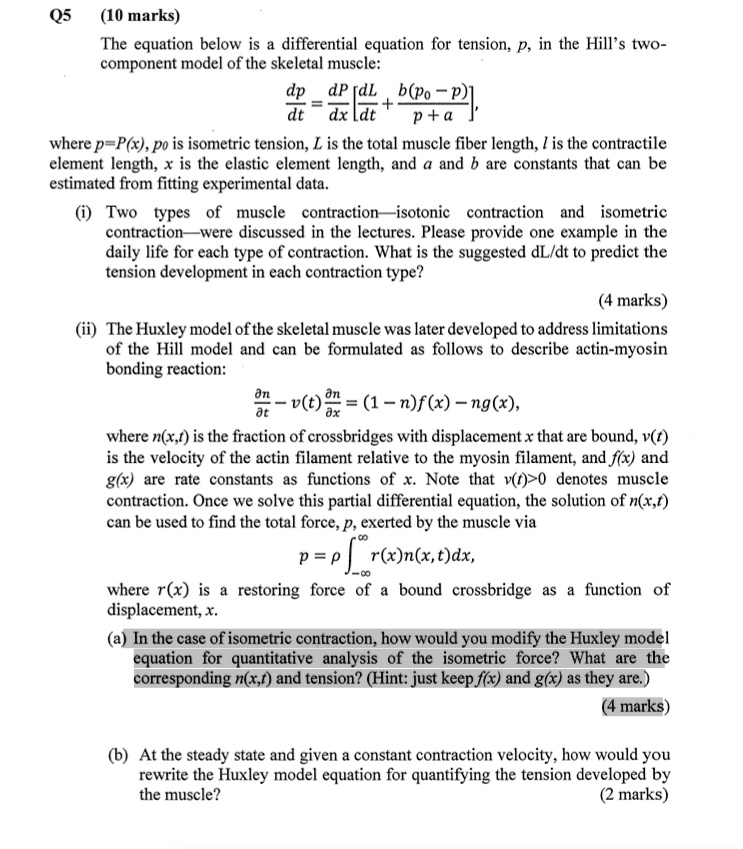
The equation below is a differential equation for tension, p, in the Hill's two-
component model of the skeletal muscle:
(dp)/(dt)=(dP)/(dx)[(dL)/(dt)+(b(p_(0)-p))/(p+a)]
where p=P(x),p_(0) is isometric tension, L is the total muscle fiber length, l is the contractile
element length, x is the elastic element length, and a and b are constants that can be
estimated from fitting experimental data.
(i) Two types of muscle contraction-isotonic contraction and isometric
contraction-were discussed in the lectures. Please provide one example in the
daily life for each type of contraction. What is the suggested d(L)/(d)t to predict the
tension development in each contraction type?
(4 marks)
(ii) The Huxley model of the skeletal muscle was later developed to address limitations
of the Hill model and can be formulated as follows to describe actin-myosin
bonding reaction:
(deln)/(delt)-v(t)(deln)/(delx)=(1-n)f(x)-ng(x),
where n(x,t) is the fraction of crossbridges with displacement x that are bound, v(t)
is the velocity of the actin filament relative to the myosin filament, and f(x) and
g(x) are rate constants as functions of x. Note that v(t)>0 denotes muscle
contraction. Once we solve this partial differential equation, the solution of n(x,t)
can be used to find the total force, p, exerted by the muscle via
p=
ho int_(-infty )^(infty ) r(x)n(x,t)dx,
where r(x) is a restoring force of a bound crossbridge as a function of
displacement, x.
(a) In the case of isometric contraction, how would you modify the Huxley model
equation for quantitative analysis of the isometric force? What are the
corresponding n(x,t) and tension? (Hint: just keep f(x) and g(x) as they are.)
(4 marks)
(b) At the steady state and given a constant contraction velocity, how would you
rewrite the Huxley model equation for quantifying the tension developed by
the muscle?
(2 marks)
x and y are in meters.
(a) Determine F.
(b) Suppose the object moves from position 1 to position 2 along the paths A and B.
Determine the work done by F along each path.
(Answers: (a) F=-4xi +j (N), (b) U_(1-2)^(A)=U_(1-2)^(B)=-1N-m )
Q5
(10 marks)
The equation below is a differential equation for tension, p, in the Hill's two component model of the skeletal muscle: dpdP[dL,b(Po-p)] dtdxlat p+a where p=P(xpo is isometric tension,L is the total muscle fiber length,l is the contractile element length, x is the elastic element length, and a and b are constants that can be estimated from fitting experimental data.
(i Two types of muscle contraction-isotonic contraction and isometric contraction-were discussed in the lectures. Please provide one example in the daily life for each type of contraction. What is the suggested dL/dt to predict the tension development in each contraction type?
(4 marks) (ii) The Huxley model of the skeletal muscle was later developed to address limitations of the Hill model and can be formulated as follows to describe actin-myosin bonding reaction:
e
where n(x,t is the fraction of crossbridges with displacement x that are bound,v(t) is the velocity of the actin filament relative to the myosin filament, and f(x and gx are rate constants as functions of x. Note that v(>0 denotes muscle contraction.Once we solve this partial differential equation, the solution of nx,t) can be used to find the total force, p, exerted by the muscle via
p=p r(x)n(x,t)dx,
where r(x) is a restoring force of a bound crossbridge as a function of displacement, x.
a In the case of isometric contraction,how would you modify the Huxley model equation for quantitative analysis of the isometric force? What are the corresponding n(x,t) and tension? (Hint: just keep f(x) and g(x) as they are.)
(4 marks)
b At the steady state and given a constant contraction velocity, how would you rewrite the Huxley model equation for quantifying the tension developed by the muscle? (2 marks)