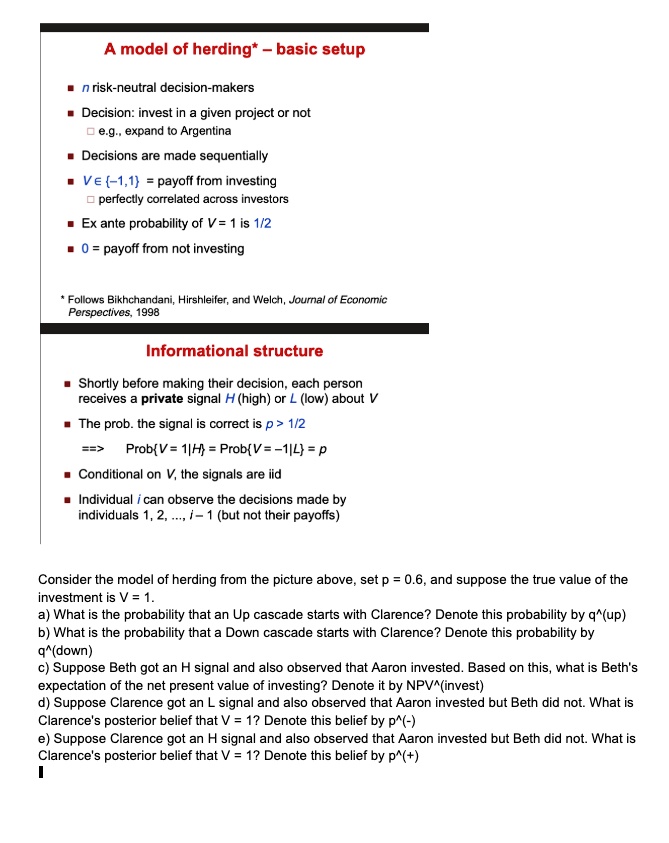
A model of herding* - basic setup
■n risk-neutral decision-makers
■ Decision: invest in a given project or not
e.g., expand to Argentina
Decisions are made sequentially
■ $V \in \{-1,1\}$ = payoff from investing
perfectly correlated across investors
■ Ex ante probability of V = 1 is 1/2
■ 0 = payoff from not investing
* Follows Bikhchandani, Hirshleifer, and Welch, Journal of Economic
Perspectives, 1998
Informational structure
■ Shortly before making their decision, each person
receives a private signal H (high) or L (low) about V
■ The prob. the signal is correct is p > 1/2
==>
$Prob\{V = 1|H\} = Prob\{V=-1|L\} = p$
■ Conditional on V, the signals are iid
■ Individual i can observe the decisions made by
individuals 1, 2, ..., i - 1 (but not their payoffs)
Consider the model of herding from the picture above, set p = 0.6, and suppose the true value of the
investment is V = 1.
a) What is the probability that an Up cascade starts with Clarence? Denote this probability by q^(up)
b) What is the probability that a Down cascade starts with Clarence? Denote this probability by
q^(down)
c) Suppose Beth got an H signal and also observed that Aaron invested. Based on this, what is Beth's
expectation of the net present value of investing? Denote it by NPV^(invest)
d) Suppose Clarence got an L signal and also observed that Aaron invested but Beth did not. What is
Clarence's posterior belief that V = 1? Denote this belief by p^(-)
e) Suppose Clarence got an H signal and also observed that Aaron invested but Beth did not. What is
Clarence's posterior belief that V = 1? Denote this belief by p^(+)