Question3: Synchronous Counter
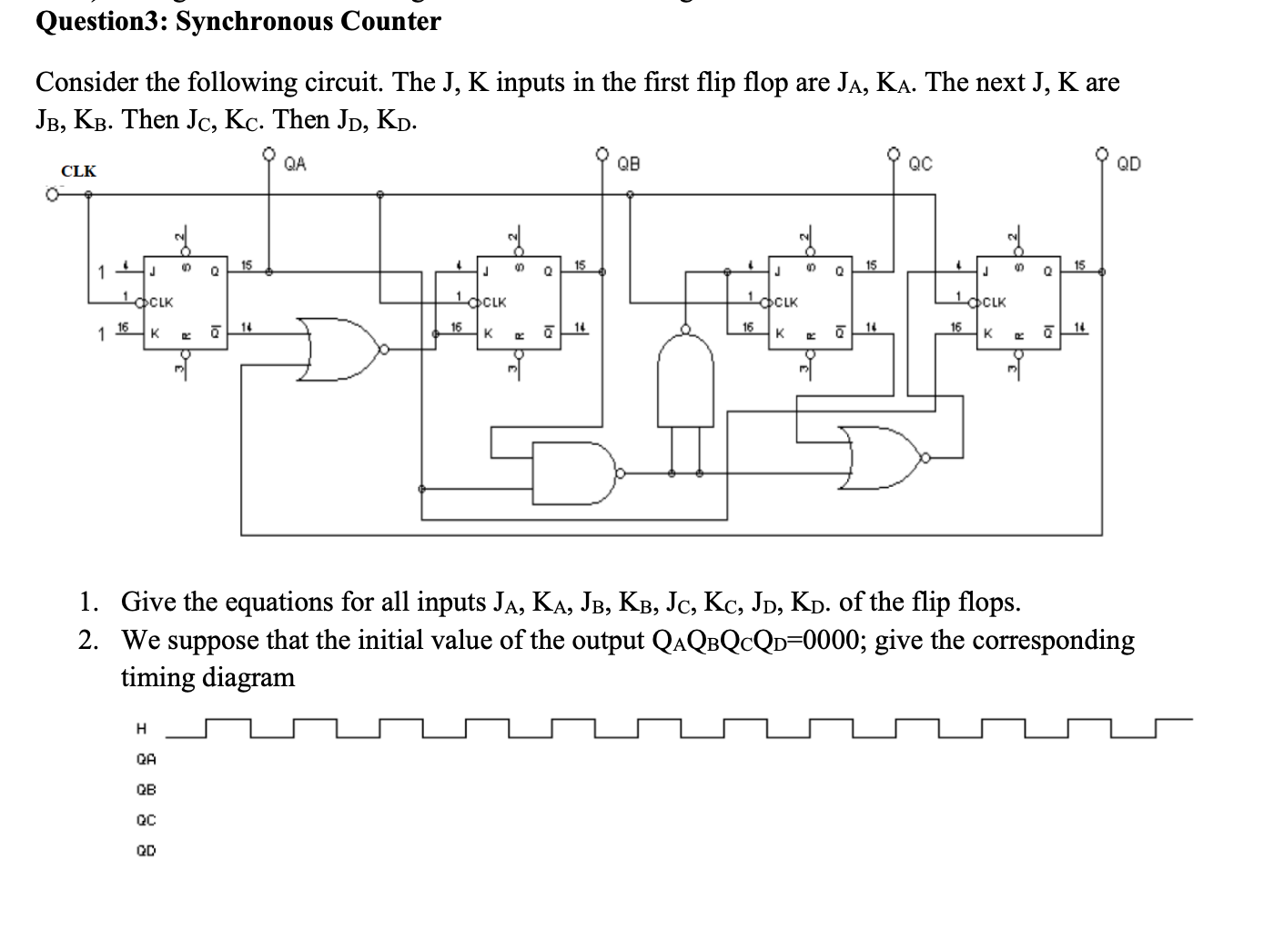
Consider the following circuit. The J, K inputs in the first flip flop are \( \mathrm{J}_{\mathrm{A}}, \mathrm{K}_{\mathrm{A}} \). The next \( \mathrm{J}, \mathrm{K} \) are \( \mathrm{J}_{\mathrm{B}}, \mathrm{K}_{\mathrm{B}} \). Then \( \mathrm{J}_{\mathrm{C}}, \mathrm{K}_{\mathrm{C}} \). Then \( \mathrm{J}_{\mathrm{D}}, \mathrm{K}_{\mathrm{D}} \).
1. Give the equations for all inputs \( \mathrm{J}_{\mathrm{A}}, \mathrm{K}_{\mathrm{A}}, \mathrm{J}_{\mathrm{B}}, \mathrm{K}_{\mathrm{B}}, \mathrm{J}_{\mathrm{C}}, \mathrm{K}_{\mathrm{C}}, \mathrm{J}_{\mathrm{D}}, \mathrm{K}_{\mathrm{D}} \). of the flip flops.
2. We suppose that the initial value of the output \( \mathrm{Q}_{A} \mathrm{Q}_{\mathrm{B}} \mathrm{Q}_{\mathrm{C}} \mathrm{Q}_{\mathrm{D}}=0000 \); give the corresponding timing diagram
H \( \square \)
\( \square \)
\( \square \)
\( \square \)
\( \square \)
\( \square \)
\( \square \)
\( \square \)
\( \square \)
\( \square \)
\( \square \)
\( \square \)
\( \square \)
\( \square \)
\( \square \)
\( \square \)
\( \square \)
\( \square \)
\[
\sqrt{\square}
\]
QA
QC
QD