size()
*/
public int size() {
}
return (size (root));
private static int size (Node node) {}
This problem demonstrates simple binary tree traversal. Given a binary tree, count the number of nodes in the tree.
maxDepth()
Given a binary tree, compute its "maxDepth" -- the number of nodes along the longest path from the root node down
to the farthest leaf node. The maxDepth of the empty tree is 0, the maxDepth of the tree on the first page is 2.
printInorder()
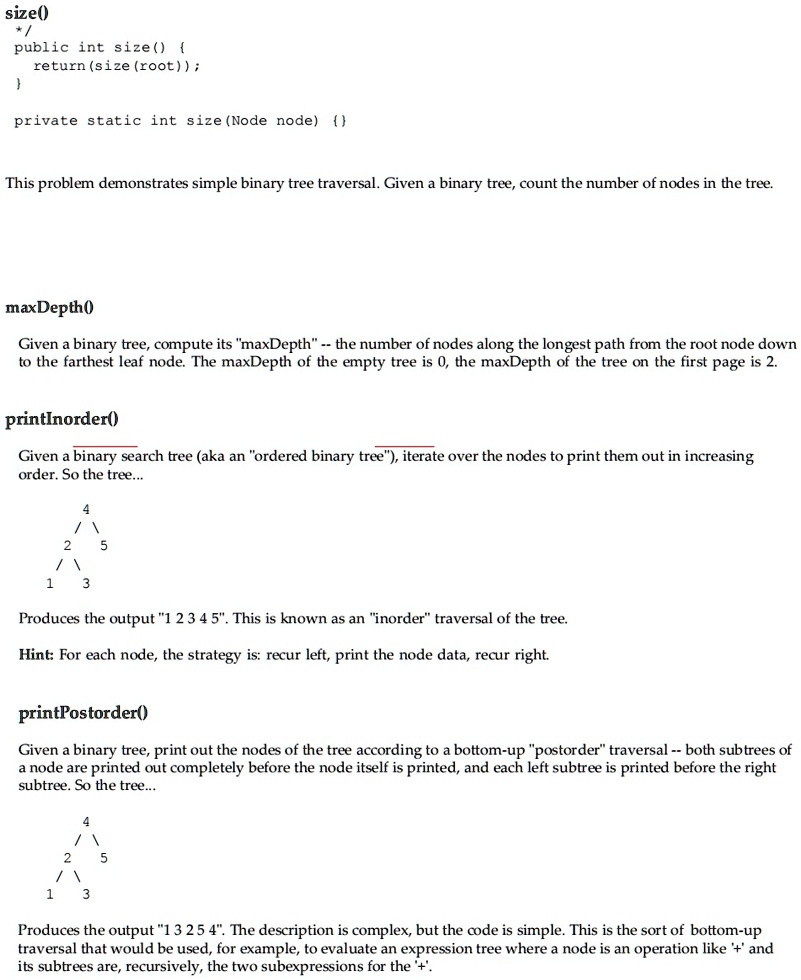
Given a binary search tree (aka an "ordered binary tree"), iterate over the nodes to print them out in increasing
order. So the tree...
1
3
Produces the output "1 2 3 4 5". This is known as an "inorder" traversal of the tree.
Hint: For each node, the strategy is: recur left, print the node data, recur right.
printPostorder()
Given a binary tree, print out the nodes of the tree according to a bottom-up "postorder" traversal -- both subtrees of
a node are printed out completely before the node itself is printed, and each left subtree is printed before the right
subtree. So the tree...
3
Produces the output "1 3 2 5 4". The description is complex, but the code is simple. This is the sort of bottom-up
traversal that would be used, for example, to evaluate an expression tree where a node is an operation like '+' and
its subtrees are, recursively, the two subexpressions for the '+'.