Problem 3
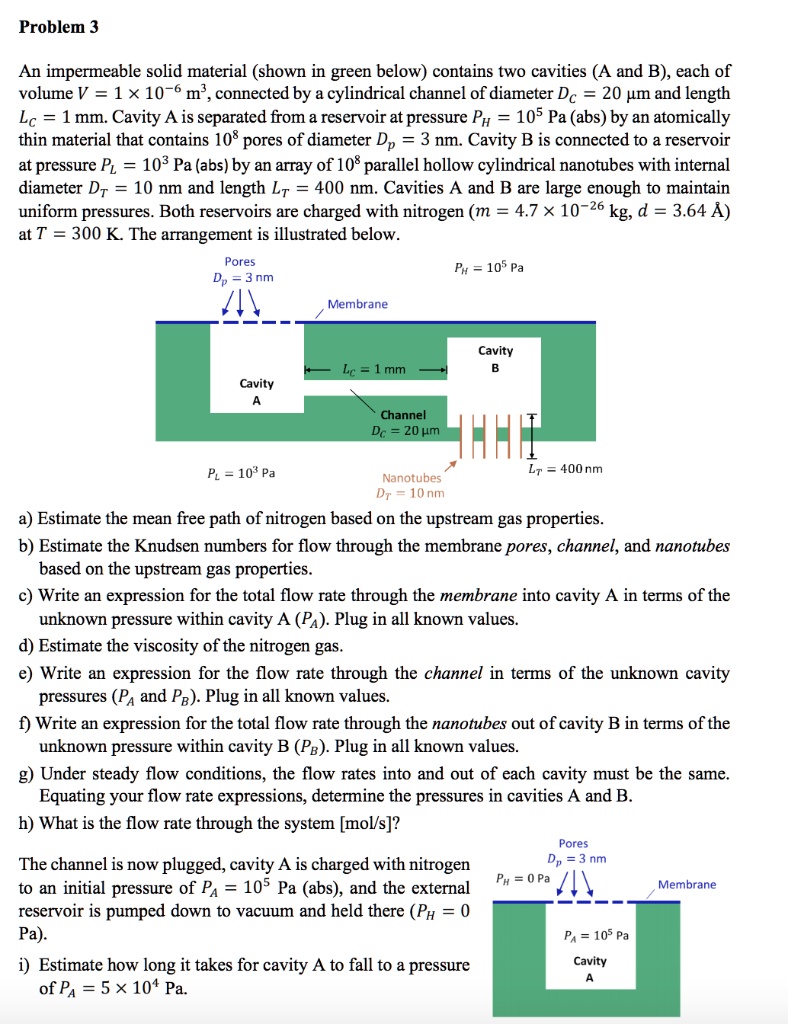
An impermeable solid material (shown in green below) contains two cavities (A and B), each of volume V = 1 x 10^-6 m^3, connected by a cylindrical channel of diameter Dc = 20 nm and length Lc = 1 mm. Cavity A is separated from a reservoir at pressure P = 10^5 Pa (abs) by an atomically thin material that contains 10 pores of diameter Dp = 3 nm. Cavity B is connected to a reservoir at pressure P = 10 Pa (abs) by an array of 10 parallel hollow cylindrical nanotubes with internal diameter D = 10 nm and length LT = 400 nm. Cavities A and B are large enough to maintain uniform pressures. Both reservoirs are charged with nitrogen (m = 4.7 x 10^-26 kg, d = 3.64 A) at T = 300 K. The arrangement is illustrated below:
Pores Dp = 3 nm
P = 10^5 Pa
Membrane
Cavity B
Lc = 1 mm
Cavity A
Channel Dc = 20 nm
P = 10^3 Pa
Nanotubes D = 10 nm
Lc = 400 nm
a) Estimate the mean free path of nitrogen based on the upstream gas properties.
b) Estimate the Knudsen numbers for flow through the membrane pores, channel, and nanotubes based on the upstream gas properties.
c) Write an expression for the total flow rate through the membrane into cavity A in terms of the unknown pressure within cavity A (PA). Plug in all known values.
d) Estimate the viscosity of the nitrogen gas.
e) Write an expression for the flow rate through the channel in terms of the unknown cavity pressures (Pa and P). Plug in all known values.
f) Write an expression for the total flow rate through the nanotubes out of cavity B in terms of the unknown pressure within cavity B (P). Plug in all known values.
g) Under steady flow conditions, the flow rates into and out of each cavity must be the same. Equating your flow rate expressions, determine the pressures in cavities A and B.
h) What is the flow rate through the system [mol/s]?
Pores Dp = 3 nm
P = 0 Pa
The channel is now plugged, cavity A is charged with nitrogen to an initial pressure of PA = 10^5 Pa (abs), and the external reservoir is pumped down to vacuum and held there (P = 0 Pa).
Membrane
PA = 10^5 Pa
Cavity A
i) Estimate how long it takes for cavity A to fall to a pressure of PA = 5 x 10^4 Pa.