Please help with both the Python code and the memo part. Thank you!
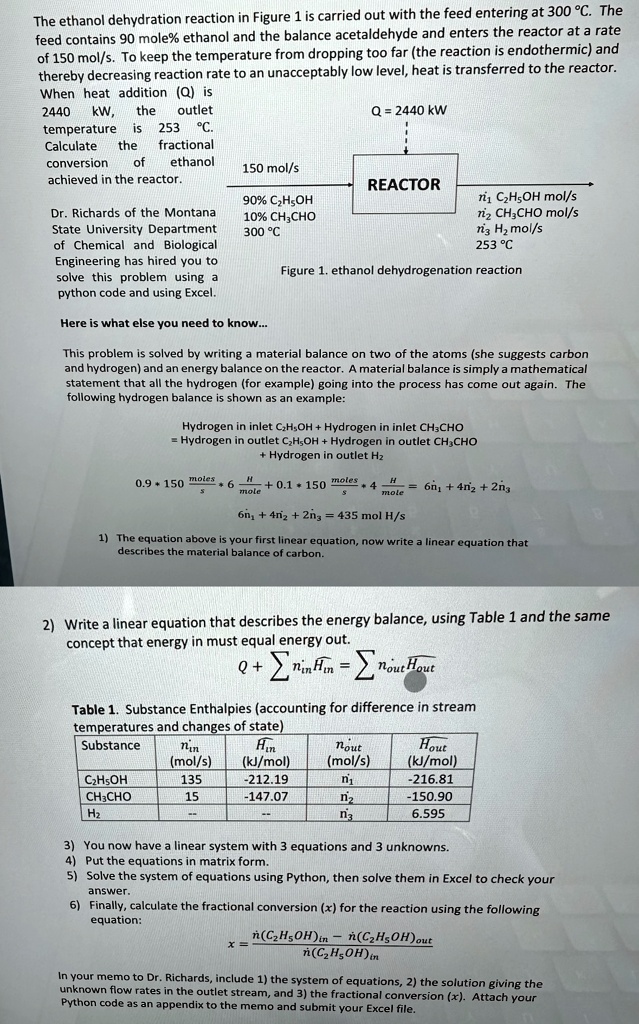
Write a linear equation that describes the energy balance, using Table 1 and the same concept that energy in must equal energy out.
Q + ∑ n_(in)∧(H_(in)) = ∑ (n_(out))/(b)ar (H_(out))
Table 1. Substance Enthalpies (accounting for difference in stream temperatures and changes of state)
You now have a linear system with 3 equations and 3 unknowns. Put the equations in matrix form.
Solve the system of equations using Python, then solve them in Excel to check your answer.
Finally, calculate the fractional conversion (x) for the reaction using the following equation:
x = ((n^(˙))(C_(2)H_(5)OH)_(in) - (n^(˙))(C_(2)H_(5)OH)_(out)) / ((n^(˙))(C_(2)H_(5)OH)_(in))
In your memo to Dr. Richards, include 1) the system of equations, 2) the solution giving the unknown flow rates in the outlet stream, and 3) the fractional conversion (x). Attach your Python code as an appendix to the memo and submit your Excel file.
The ethanol dehydration reaction in Figure 1 is carried out with the feed entering at 300°C. The feed contains 90 mole% ethanol and the balance acetaldehyde and enters the reactor at a rate thereby decreasing reaction rate to an unacceptably low level, heat is transferred to the reactor. When heat addition Q is 2440 kW the outlet Q = 2440 kW temperature is 253°C. Calculate the fractional conversion of ethanol 150 mol/s achieved in the reactor.
REACTOR 90% CH3OH iCH3OH mol/s Dr. Richards of the Montana 10% CH3CHO niz CH3CHO mol/s State University Department 300 iHmol/s of Chemical and Biological 253 Engineering has hired you to Figure 1. ethanol dehydrogenation reaction solve this problem using a Python code and using Excel.
Here is what else you need to know...
This problem is solved by writing a material balance on two of the atoms (she suggests carbon and hydrogen) and an energy balance on the reactor. A material balance is simply a mathematical statement that all the hydrogen (for example) going into the process has come out again. The following hydrogen balance is shown as an example:
Hydrogen in inlet CH3OH + Hydrogen in inlet CH3CHO = Hydrogen in outlet CH3OH + Hydrogen in outlet CH3CHO + Hydrogen in outlet H
6n + 4n + 2n = 435 mol H/s
1) The equation above is your first linear equation, now write a linear equation that describes the material balance of carbon.
2) Write a linear equation that describes the energy balance, using Table 1 and the same concept that energy in must equal energy out. Q + nimHin = noueHout
Table 1. Substance Enthalpies (accounting for difference in stream temperatures and changes of state)
Substance uru Hin nout Hout (mol/s) (kJ/mol) (mol/s) (kJ/mol) CH3OH 135 -212.19 ni -216.81 CH3CHO 15 -147.07 n2 -150.90 H2 n3 6.595
3) You now have a linear system with 3 equations and 3 unknowns 4) Put the equations in matrix form. 5) Solve the system of equations using Python, then solve them in Excel to check your answer. 6) Finally, calculate the fractional conversion x for the reaction using the following equation: nCH3OHin - nCH3OHout / nCH3OHin
In your memo to Dr. Richards, include 1) the system of equations, 2) the solution giving the unknown flow rates in the outlet stream, and 3) the fractional conversion (x). Attach your Python code as an appendix to the memo and submit your Excel file.