Viewed Questions
(i) Write the equation of the system of circles having the line of centres as $\mathrm{y}$ -axis and radical axis as the $\mathrm{x}$ -axis. (ii) Find the differential equation of above system.
When a $6.50-\mathrm{g}$ sample of solid sodium hydroxide dissolves in $100.0 \mathrm{~g}$ of water in a coffee-cup calorimeter (Figure 5.18 ), the temperature rises from $21.6^{\circ} \mathrm{C}$ to $37.8^{\circ} \mathrm{C}$. Calculate $\Delta H$ (in $\mathrm{kJ} / \mathrm{mol} \mathrm{NaOH})$ for the solution process $$ \mathrm{NaOH}(s) \longrightarrow \mathrm{Na}^{+}(a q)+\mathrm{OH}^{-}(a q) $$ Assume that the specific heat of the solution is the same as that of pure water.
Questions asked
Likhit Ganedi
Numerade educator
Suppose a particle is moving in such a way that its position at time ( t ) is [ s(t)=t^{3}-6 t^{2}+9 t+3 ] At what time(s) is the particle at rest?
Jacob Fry
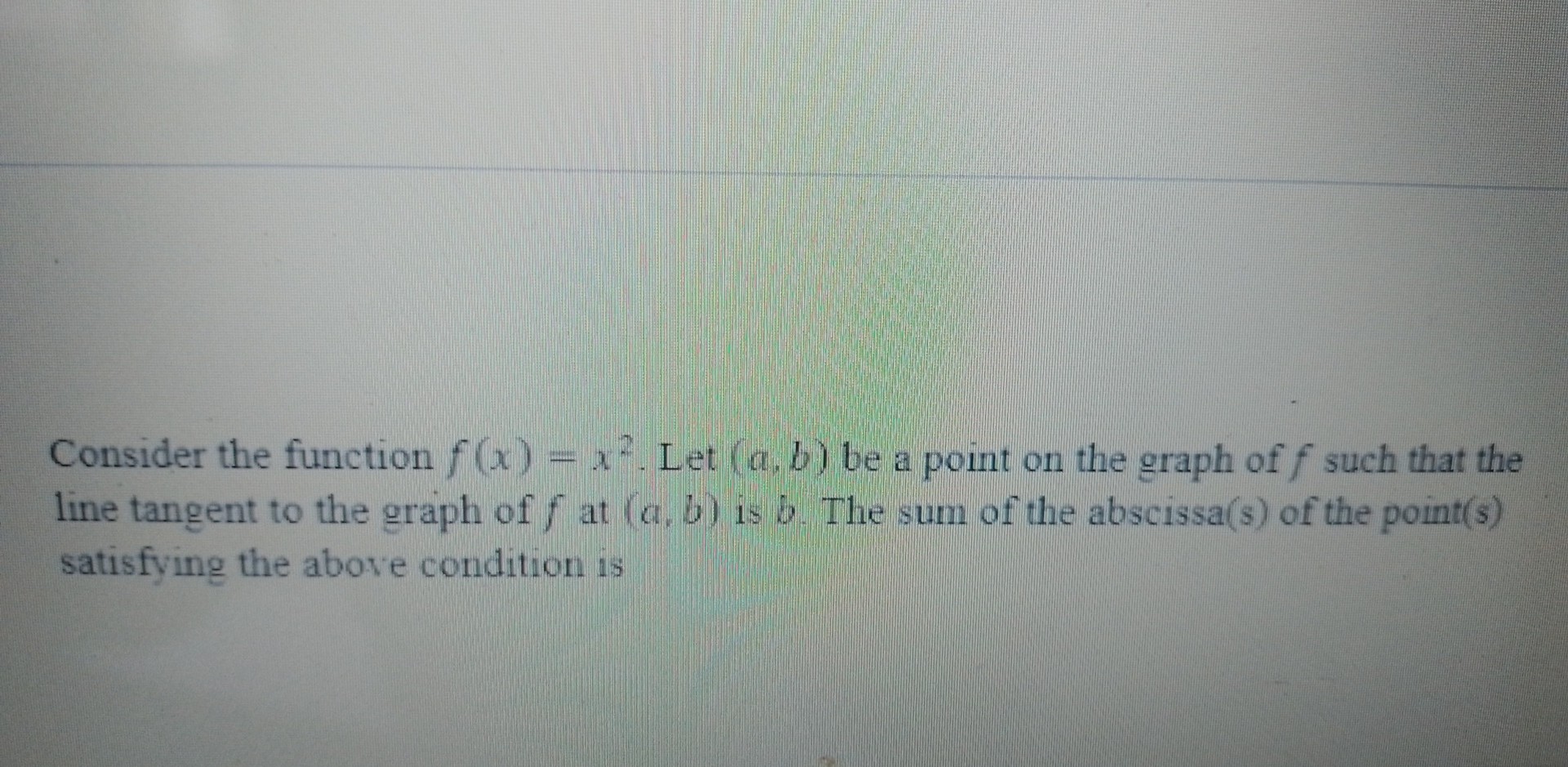
Consider the function f(x) = x². Let (a, b) be a point on the graph of f such that the line tangent to the graph of f at (a, b) is b. The sum of the abscissa(s) of the point(s) satisfying the above condition is
Suppose a particle is moving horizontally in such a way that its position at time ( t ) is [ s(t)=t^{3}-6 t^{2}+9 t+3 ] On the interval ( [0,3] ), when is the particle speeding up?
Consider the graph of ( y=x^{2}+8 x+1 ). Its tangent line at ( x=3 ) passes through ( (9, b) ) where ( b ) is
A man drops a ball from a very tall building. How far does the ball fall after four seconds?
Consider the graph of the function f(x) = x^2. Let (a, b) be the point on the graph of f closest to (3,0). What is a + b?
Suppose a particle is moving horizontally in such a way that its position at time ( t ) is [ s(t)=t^{3}-6 t^{2}+9 t+3 ] What is the total distance traveled by the particle from time ( t=0 ) to time ( t=2 ) ?
Suppose a particle is moving horizontally in such a way that its position at time ( t ) is [ s(t)=t^{3}-6 t^{2}+9 t+3 . ] When is the particle moving to the left?
What is the instantaneous rate of change of ( f(x)=-frac{3}{4} x+2 ) ?
What is the average rate of change of ( f(x)=x^{2}-2 ) on the interval ( [-2,-1] ) ?