Ace - AI Tutor
Ask Our Educators
Textbooks
My Library
Flashcards
Scribe - AI Notes
Notes & Exams
Download App
ronald barnes

ronald b.

Divider

Questions asked

BEST MATCH

. You examined the effects of heat on equilibrium in Part IV. Was the reaction you observed endo- or exo- thermic? Does heat act as a reactant or product? What happened when you removed heat by placing the solution in the ice bath? What would you expect to happen if you were to add heat?

View Answer
divider
BEST MATCH

the answer choice that best completes the statement or answers the question. ind the remainder when 2x^(3)+x^(2)+3x+7 is divided by x+2. Is the binomial a factor of the polynomial?

View Answer
divider
BEST MATCH

The body's natural production of endorphins is likely to be O increased by heroin use and increased by vigorous exercise. O decreased by heroin use and decreased by vigorous exercise. O increased by heroin use and decreased by vigorous exercise. O decreased by heroin use and increased by vigorous exercise.

View Answer
divider
BEST MATCH

A 6 kg block is in contact with a 4 kg block on a horizontal

View Answer
divider
BEST MATCH

1. Plot the functions below. Make sure to choose \(t\) values such that the major features of \(f(t)\) are included. Then find their Fourier transforms using the Fourier integral: \(F(\omega) = \int_{-\infty}^{\infty} f(t)e^{-j\omega t}dt\) Using the tables instead of the Fourier integral is acceptable for (e). (a) \(f(t) = Kt[u(t - A/2) - u(t + A/2)]\). What is the value of \(F(0)\)? (b) \(f(t) = 2t^2e^{-|t|}\). (c) \(f(t) = Ae^{-2(t-1)}u(t - 1)\). (d) For the following \(f(t)\), set the range of the plot to \(-10 < t < 10\). \(f(t) = \begin{cases} -5 & -1 < t < 0 \\ 5 & 0 < t < 1 \\ 0 & \text{elsewhere} \end{cases}\) (e) \(f(t) = e^{-\alpha|t|}\sin(\omega_0 t)\).

View Answer
divider
BEST MATCH

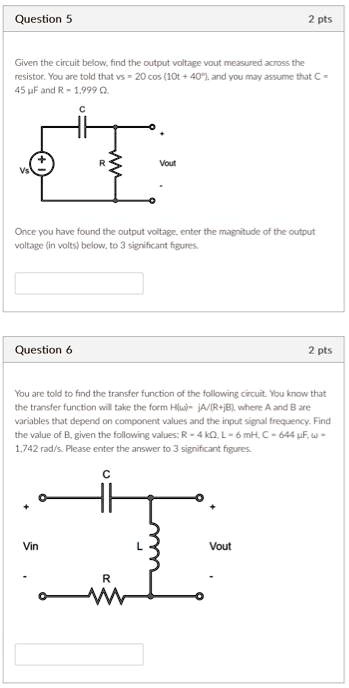
Question 5 2 pts Given the circuit below, find the output voltage $v_{out}$ measured across the resistor. You are told that $v_s = 20 \cos(10t + 40^\circ)$, and you may assume that $C =$ 45 µF and $R = 1,999 \Omega$. $V_s$ $C$ $+$ $R$ $V_{out}$ Once you have found the output voltage, enter the magnitude of the output voltage (in volts) below, to 3 significant figures. Question 6 2 pts You are told to find the transfer function of the following circuit. You know that the transfer function will take the form $H(jw) = \frac{jA}{(R+jB)}$, where A and B are variables that depend on component values and the input signal frequency. Find the value of B, given the following values: $R = 4 \text{ k}\Omega$, $L = 6 \text{ mH}$, $C = 644 \text{ µF}$, $\omega =$ 1,742 rad/s. Please enter the answer to 3 significant figures $C$ $V_{in}$ $L$ $V_{out}$ $R$
View Answer
divider
BEST MATCH

Texts: Use a table similar to that shown in Fig. 3.10 to calculate 72 divided by 21. Assume both inputs are unsigned 8-bit integers. [The base is 10] 192 Chapter 3: Arithmetic for Computers Divisor Remainder 00100000 00000111 00100000 00000111 00010000 00000111 00010000 1110111 00010000 00000111 00001000 00000111 00001000 1111111 00001000 00000111 00000100 00000111 00000100 00000011 00000100 00000011 00000010 00000011 00000010 00000001 00000010 00000001 00000001 00000001 00000001 00000001 Quotient 00000000 00000000 00000000 00000000

View Answer
divider
BEST MATCH

Use the formula $\kappa(t) = \frac{||r'(t) \times r''(t)||}{||r'(t)||^3}$ to find $\kappa(t)$.\newline$r(t) = e^{3t}\mathbf{i} + e^{-t}\mathbf{j}$\newline$\kappa(t) = \frac{12e^{-2t}}{(9e^{6t} + e^{-2t})^{\frac{3}{2}}}$

View Answer
divider
BEST MATCH

Part 2: Write the JOIN statements JOIN Comment INNER JOIN (use ON) Use ON keyword INNER JOIN (use WHERE) Do NOT use ON; Use WHERE INNER JOIN Do NOT use JOIN. Rely on default join behavior Use WHERE LEFT OUTER JOIN Ensure that you use "OUTER" keyword RIGHT OUTER JOIN Ensure that you use "OUTER" keyword You will be matching ON customer.id with order.customer_id Please note that the column names in this exercise are intentionally kept different. You should NOT be changing the DDL.

View Answer
divider
BEST MATCH

Calculate the half-life and decay Constant of a radionuclide if it's activity decreased by a. 70% during the day; b. 0.02% during the minute.

View Answer
divider