Problem 1: As discussed in class a system of springs and dampers and no masses can be
used as model for a viscoelastic material (http://en.wikipedia.org/wiki/Viscoelasticity).
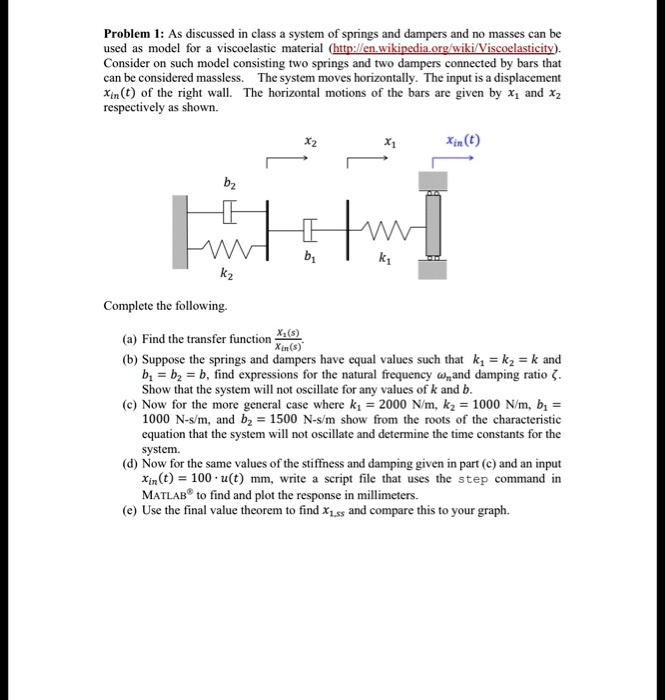
Consider on such model consisting two springs and two dampers connected by bars that
can be considered massless. The system moves horizontally. The input is a displacement
$x_{in}(t)$ of the right wall. The horizontal motions of the bars are given by $x_1$ and $x_2$
respectively as shown.
$x_2$
$x_1$
$x_{in}(t)$
b2
$b_1$
$k_1$
$k_2$
Complete the following.
(a) Find the transfer function $\frac{x_1(s)}{x_{in}(s)}$
(b) Suppose the springs and dampers have equal values such that $k_1 = k_2 = k$ and
$b_1 = b_2 = b$, find expressions for the natural frequency $\omega_n$ and damping ratio $\zeta$.
Show that the system will not oscillate for any values of $k$ and $b$.
(c) Now for the more general case where $k_1 = 2000$ N/m, $k_2 = 1000$ N/m, $b_1 =$
1000 N-s/m, and $b_2 = 1500$ N-s/m show from the roots of the characteristic
equation that the system will not oscillate and determine the time constants for the
system.
(d) Now for the same values of the stiffness and damping given in part (c) and an input
$x_{in}(t) = 100 u(t)$ mm, write a script file that uses the `step` command in
MATLAB® to find and plot the response in millimeters.
(e) Use the final value theorem to find $x_{1,ss}$ and compare this to your graph.