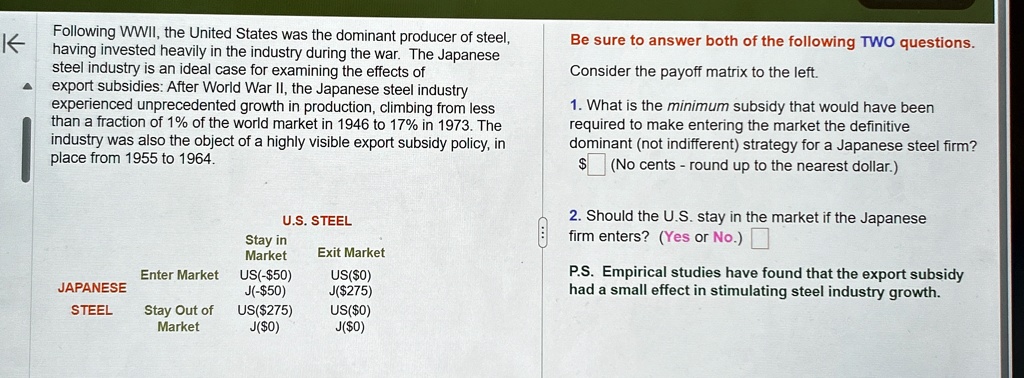
Following WWII, the United States was the dominant producer of steel, having invested heavily in the industry during the war. The Japanese steel industry is an ideal case for examining the effects of export subsidies: After World War II, the Japanese steel industry experienced unprecedented growth in production, climbing from less than a fraction of 1% of the world market in 1946 to 17% in 1973. The industry was also the object of a highly visible export subsidy policy, in place from 1955 to 1964.
Stay in
Market
U.S. STEEL
Exit Market
Enter Market
JAPANESE
US(-$50)
J(-$50)
US($0)
J($275)
STEEL
Stay Out of
Market
US($275)
US($0)
J($0)
J($0)
Be sure to answer both of the following TWO questions.
Consider the payoff matrix to the left.
1. What is the minimum subsidy that would have been required to make entering the market the definitive dominant (not indifferent) strategy for a Japanese steel firm?
$ (No cents - round up to the nearest dollar.)
2. Should the U.S. stay in the market if the Japanese firm enters? (Yes or No.)
P.S. Empirical studies have found that the export subsidy had a small effect in stimulating steel industry growth.