Ace - AI Tutor
Ask Our Educators
Textbooks
My Library
Flashcards
Scribe - AI Notes
Notes & Exams
Download App
ronald mascar-

ronald m.

Divider

Questions asked

BEST MATCH

Jim's diner is just about to open in Memphis, Tennessee. However, Jim is trying to decide whether he wants to offer Coke or Pepsi soda products. He determines that to offer either product, he will have to spend $2,500 in sunk costs to purchase and install the appropriate paraphernalia, e.g., a large Coca-Cola or Pepsi sign out front. Ultimately, he chooses to offer Coke products and agrees to pay Coke 5 cents per ounce of Coke sold for the right to use its product. After Jim makes the investments specific to his soda choice. What is the most Jim should be willing to pay? $ 2500.05

View Answer
divider
BEST MATCH

I've been tasked with reporting on recruitment, and I'm supposed to incorporate recruiting yields ratios. Do you know what those are?

View Answer
divider
BEST MATCH

Question 19 (4 points) Listen Today, spending money to find new customers is more important than retaining and maintaining current customers True False

View Answer
divider
BEST MATCH

QUESTION 1 (a) Briefly outline the importance of material selection in engineering applications. In your explanation, cite suitable examples where poor material selection has been (or can be) detrimental (5 Marks) (b) Briefly explain the main difference between ionic, covalent and metallic bonding. (5 Marks) (c) Match the following types of material to the bonding nature described above. Metals • Ceramics • Glass • Polymers • Semiconductors (5 Marks) (d) Show that the atomic packing factor for a simple cubic cell is 0.524. How would this vary for BCC and FCC packing arrangements? (5 Marks)

View Answer
divider
BEST MATCH

The depletion of ozone (O3) in the stratosphere has been a matter of great concern among scientists in recent years. It is believed that ozone can react with nitric oxide (NO) that is discharged from high altitude planes. The reaction is O3 + NO  O2 + NO2 If 0.0150 mol of O3 reacts with 0.0223 mol of NO, what is the limiting reactant? (3 pts) a. NO b. O3 c. O2 d. Both NO and O3 are limiting reagents. e. Both NO and O3 are excess reagents. 7. What is the maximum mass of NO2 that can form in question 6? (3 pts) a. 0.709 g b. 1.00 g c. 0.680 g d. 0.334 g e. 1.02 g

View Answer
divider
BEST MATCH

The central sulcus of the brain divides the parietal and temporal lobes of the brain. True False

View Answer
divider
BEST MATCH

Kinetic and Potential Energy Student Try Ace AISTEM Tutor by Nun student.masteryconnect.com Washington, Roland Potential and Kinetic Energy Post-Test 24 of 31 19 20 21 22 \( 23 \quad 24 \) 25 26 27 28 Finish The diagram shows the potential energy (PE) and kinetic energy (KE) of a car in motion. What can be said about the energy of the car? The total energy of the car varies as it moves from one point to another. The potential energy of the car increases as it moves down the slope. The total energy of the car is the sum of the potential energy and kinetic energy. The difference between the potential and kinetic energy gives the total energy of the car.

View Answer
divider
BEST MATCH

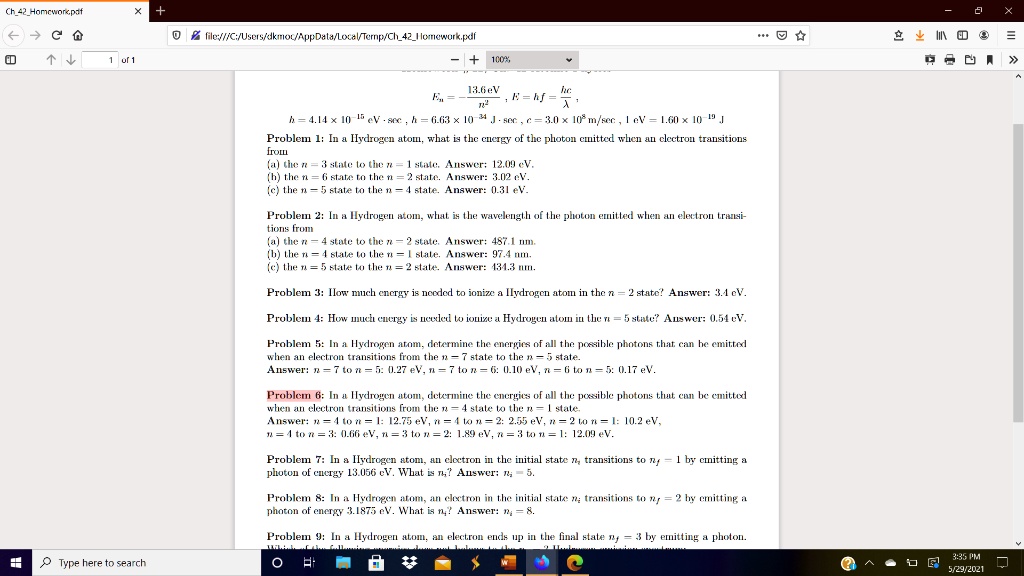
$E_n = \frac{-13.6 eV}{n^2}$ , $E = hf = \frac{hc}{\lambda}$ $h = 4.14 \times 10^{-15} eV \cdot s$ , $h = 6.63 \times 10^{-34} J \cdot s$ , $c = 3.0 \times 10^8 m/s$ , $1 eV = 1.60 \times 10^{-19} J$ Problem 1: In a Hydrogen atom, what is the energy of the photon emitted when an electron transitions from (a) the $n = 3$ state to the $n = 1$ state. Answer: 12.09 eV. (b) the $n = 6$ state to the $n = 2$ state. Answer: 3.02 eV. (c) the $n = 5$ state to the $n = 4$ state. Answer: 0.31 eV. Problem 2: In a Hydrogen atom, what is the wavelength of the photon emitted when an electron transitions from (a) the $n = 4$ state to the $n = 2$ state. Answer: 487.1 nm. (b) the $n = 4$ state to the $n = 1$ state. Answer: 97.4 nm. (c) the $n = 5$ state to the $n = 2$ state. Answer: 434.3 nm. Problem 3: How much energy is needed to ionize a Hydrogen atom in the $n = 2$ state? Answer: 3.4 eV. Problem 4: How much energy is needed to ionize a Hydrogen atom in the $n = 5$ state? Answer: 0.54 eV. Problem 5: In a Hydrogen atom, determine the energies of all the possible photons that can be emitted when an electron transitions from the $n = 7$ state to the $n = 5$ state. Answer: $n = 7$ to $n = 5$: 0.27 eV, $n = 7$ to $n = 6$: 0.10 eV, $n = 6$ to $n = 5$: 0.17 eV. Problem 6: In a Hydrogen atom, determine the energies of all the possible photons that can be emitted when an electron transitions from the $n = 4$ state to the $n = 1$ state. Answer: $n = 4$ to $n = 1$: 12.75 eV, $n = 4$ to $n = 2$: 2.55 eV, $n = 2$ to $n = 1$: 10.2 eV, $n = 4$ to $n = 3$: 0.66 eV, $n = 3$ to $n = 2$: 1.89 eV, $n = 3$ to $n = 1$: 12.09 eV. Problem 7: In a Hydrogen atom, an electron in the initial state $n_i$ transitions to $n_f = 1$ by emitting a photon of energy 13.056 eV. What is $n_i$? Answer: $n_i = 5$. Problem 8: In a Hydrogen atom, an electron in the initial state $n_i$ transitions to $n_f = 2$ by emitting a photon of energy 3.1875 eV. What is $n_i$? Answer: $n_i = 8$. Problem 9: In a Hydrogen atom, an electron ends up in the final state $n_f = 3$ by emitting a photon.
View Answer
divider
BEST MATCH

The lower the market interest rate, the lower the bond issue price will be.

View Answer
divider
BEST MATCH

Which laboratory tests should you monitor when caring for a resident who regularly takes acetaminophen (Tylenol®)?

View Answer
divider