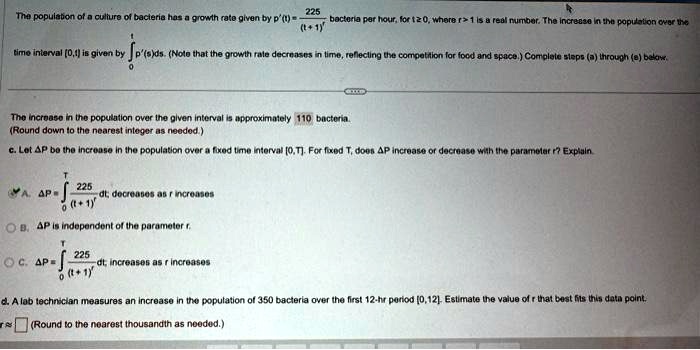
The population of a culture of bacteria has a growth rate given by $p'(t) = \frac{225}{(t+1)^r}$ bacteria per hour, for $t \ge 0$, where $r > 1$ is a real number. The increase in the population over the time interval $[0, 1]$ is given by $\int_0^1 p'(s)ds$. (Note that the growth rate decreases in time, reflecting the competition for food and space.) Complete steps (a) through (e) below.
The increase in the population over the given interval is approximately 110 bacteria.
(Round down to the nearest integer as needed.)
c. Let $\Delta P$ be the increase in the population over a fixed time interval $[0, T]$. For fixed T, does $\Delta P$ increase or decrease with the parameter r? Explain.
$\qquad A. \Delta P = \int_0^T \frac{225}{(t+1)^r} dt$; decreases as r increases
$\qquad B. \Delta P$ is independent of the parameter r.
$\qquad C. \Delta P = \int_0^T \frac{225}{(t+1)^r} dt$; increases as r increases
d. A lab technician measures an increase in the population of 350 bacteria over the first 12-hr period $[0, 12]$. Estimate the value of r that best fits this data point.
(Round to the nearest thousandth as needed.)