EXAMPLE 6.8
Collision at an Intersection
GOAL Analyze a two-dimensional inelastic collision.
PROBLEM
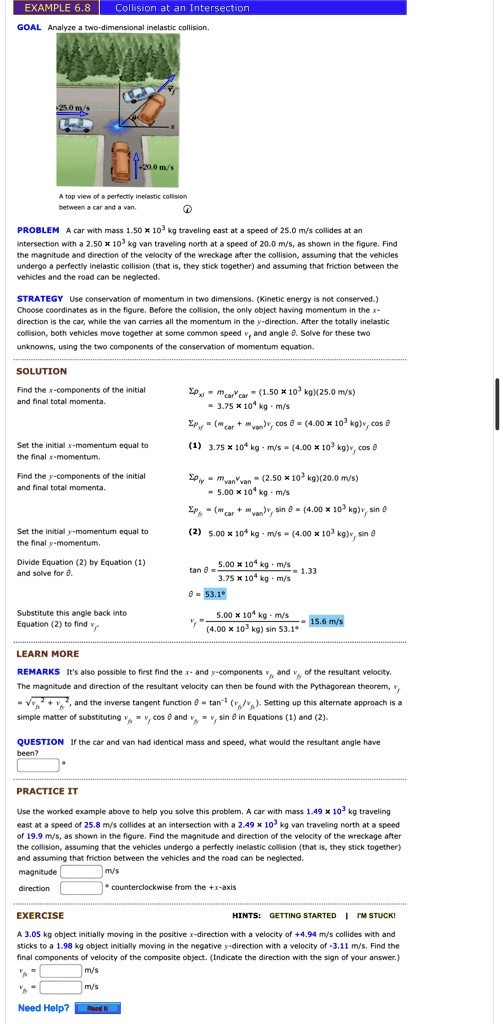
A car with mass $1.50 \times 10^3 \, kg$ traveling east at a speed of 25.0 m/s collides at an intersection with a $2.50 \times 10^3 \, kg$ van traveling north at a speed of 20.0 m/s, as shown in the figure. Find the magnitude and direction of the velocity of the wreckage after the collision, assuming that the vehicles undergo a perfectly inelastic collision (that is, they stick together) and assuming that friction between the vehicles and the road can be neglected.
STRATEGY Use conservation of momentum in two dimensions. (Kinetic energy is not conserved.) Choose coordinates as in the figure. Before the collision, the only object having momentum in the $x$-direction is the car, while the van carries all the momentum in the $y$-direction. After the totally inelastic collision, both vehicles move together at some common speed $v$, and angle $\theta$. Solve for these two unknowns, using the two components of the conservation of momentum equation.
SOLUTION
Find the $x$-components of the initial and final total momenta.
$p_{ix} = m_{car}v_{car} = (1.50 \times 10^3 \, kg)(25.0 \, m/s) = 3.75 \times 10^4 \, kg \cdot m/s$
$p_{fx} = (m_{car} + m_{van})v_f \cos \theta = (4.00 \times 10^3 \, kg)v_f \cos \theta$
(1) $3.75 \times 10^4 \, kg \cdot m/s = (4.00 \times 10^3 \, kg)v_f \cos \theta$
Set the initial $x$-momentum equal to the final $x$-momentum.
Find the $y$-components of the initial and final total momenta.
$p_{iy} = m_{van}v_{van} = (2.50 \times 10^3 \, kg)(20.0 \, m/s) = 5.00 \times 10^4 \, kg \cdot m/s$
$p_{fy} = (m_{car} + m_{van})v_f \sin \theta = (4.00 \times 10^3 \, kg)v_f \sin \theta$
(2) $5.00 \times 10^4 \, kg \cdot m/s = (4.00 \times 10^3 \, kg)v_f \sin \theta$
Set the initial $y$-momentum equal to the final $y$-momentum.
Divide Equation (2) by Equation (1) and solve for $\theta$.
$\tan \theta = \frac{5.00 \times 10^4 \, kg \cdot m/s}{3.75 \times 10^4 \, kg \cdot m/s} = 1.33$
$\theta = 53.1^\circ$
Substitute this angle back into Equation (2) to find $v_f$.
$v_f = \frac{5.00 \times 10^4 \, kg \cdot m/s}{(4.00 \times 10^3 \, kg) \sin 53.1^\circ} = 15.6 \, m/s$
LEARN MORE
REMARKS It's also possible to first find the $x$- and $y$-components $v_x$ and $v_y$ of the resultant velocity. The magnitude and direction of the resultant velocity can then be found with the Pythagorean theorem, $v = \sqrt{v_x^2 + v_y^2}$, and the inverse tangent function $\theta = \tan^{-1}(v_y/v_x)$. Setting up this alternate approach is a simple matter of substituting $v_x = v_f \cos \theta$ and $v_y = v_f \sin \theta$ in Equations (1) and (2).
QUESTION If the car and van had identical mass and speed, what would the resultant angle have been?
PRACTICE IT
Use the worked example above to help you solve this problem. A car with mass $1.49 \times 10^3 \, kg$ traveling east at a speed of 25.8 m/s collides at an intersection with a $2.49 \times 10^3 \, kg$ van traveling north at a speed of 19.9 m/s, as shown in the figure. Find the magnitude and direction of the velocity of the wreckage after the collision, assuming that the vehicles undergo a perfectly inelastic collision (that is, they stick together) and assuming that friction between the vehicles and the road can be neglected.
magnitude
direction
EXERCISE
HINTS: GETTING STARTED I'M STUCK!
A 3.05 kg object initially moving in the positive $x$-direction with a velocity of +4.94 m/s collides with and sticks to a 1.98 kg object initially moving in the negative $y$-direction with a velocity of -3.11 m/s. Find the final components of velocity of the composite object. (Indicate the direction with the sign of your answer.)
$v_{fx} = $ m/s
$v_{fy} = $ m/s