Pipettes
Pipettes are used to measure and transfer small volumes ( 10mL or less) of liquids. Pipettes are long graduated tubes that allow one to accurately measure and transfer small volumes. There are several different types and sizes of pipets, which are used for slightly different purposes. Be sure that you know how to identify the different types of pipets and that you can determine the total volume and the gradations on each.
Take a 10mL, a 5mL and a 1mL pipette from the cart.
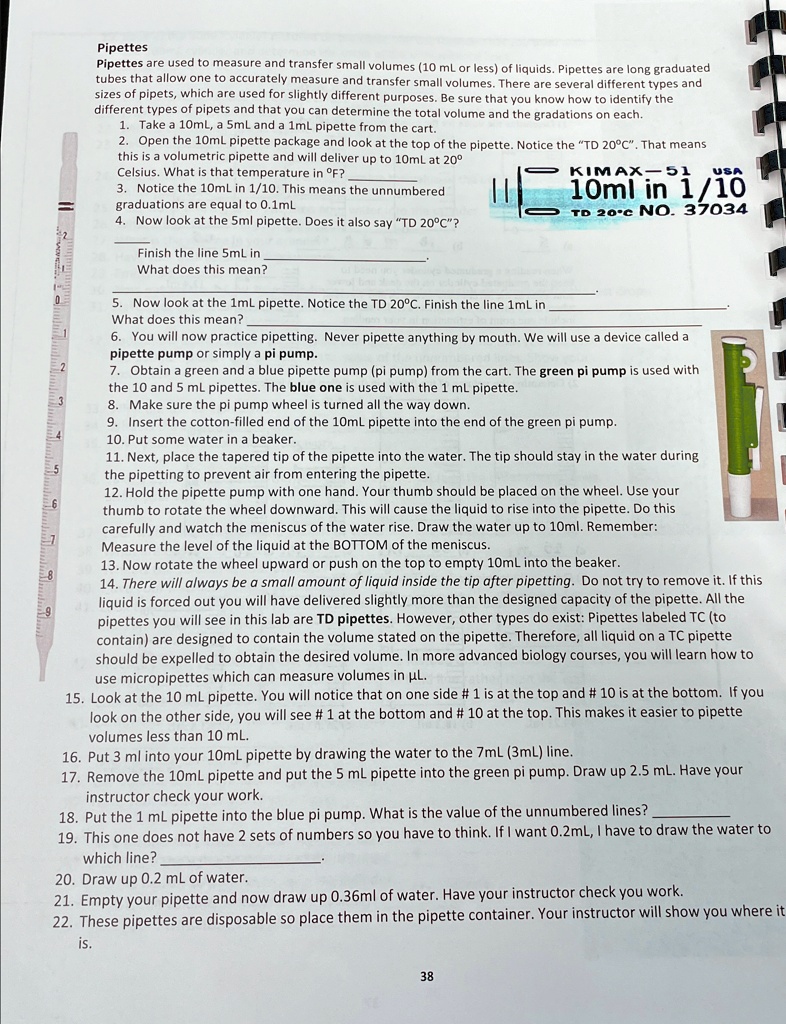
Open the 10mL pipette package and look at the top of the pipette. Notice the "TD 20deg C ". That means this is a volumetric pipette and will deliver up to 10mL at 20deg Celsius. What is that temperature in deg F ?
Notice the 10mL in (1)/(10). This means the unnumbered graduations are equal to 0.1mL
Now look at the 5ml pipette. Does it also say "TD 20deg C "?
Finish the line 5mL in
What does this mean?
Now look at the 1mL pipette. Notice the TD20deg C. Finish the line 1mL in What does this mean?
You will now practice pipetting. Never pipette anything by mouth. We will use a device called a pipette pump or simply a pi pump.
Obtain a green and a blue pipette pump (pi pump) from the cart. The green pi pump is used with the 10 and 5mL pipettes. The blue one is used with the 1mL pipette.
Make sure the pi pump wheel is turned all the way down.
Insert the cotton-filled end of the 10mL pipette into the end of the green pi pump.
Put some water in a beaker.
Next, place the tapered tip of the pipette into the water. The tip should stay in the water during the pipetting to prevent air from entering the pipette.
Hold the pipette pump with one hand. Your thumb should be placed on the wheel. Use your thumb to rotate the wheel downward. This will cause the liquid to rise into the pipette. Do this carefully and watch the meniscus of the water rise. Draw the water up to 10ml. Remember:
Measure the level of the liquid at the BOTTOM of the meniscus.
Now rotate the wheel upward or push on the top to empty 10mL into the beaker.
There will always be a small amount of liquid inside the tip after pipetting. Do not try to remove it. If this liquid is forced out you will have delivered slightly more than the designed capacity of the pipette. All the pipettes you will see in this lab are TD pipettes. However, other types do exist: Pipettes labeled TC (to contain) are designed to contain the volume stated on the pipette. Therefore, all liquid on a TC pipette should be expelled to obtain the desired volume. In more advanced biology courses, you will learn how to use micropipettes which can measure volumes in mu L.
Look at the 10mL pipette. You will notice that on one side # 1 is at the top and # 10 is at the bottom. If you look on the other side, you will see # 1 at the bottom and # 10 at the top. This makes it easier to pipette volumes less than 10mL.
Put 3ml into your 10mL pipette by drawing the water to the 7mL(3mL) line.
Remove the 10mL pipette and put the 5mL pipette into the green pi pump. Draw up 2.5mL. Have your instructor check your work.
Put the 1mL pipette into the blue pi pump. What is the value of the unnumbered lines?
This one does not have 2 sets of numbers so you have to think. If I want 0.2mL, I have to draw the water to which line?
Draw up 0.2mL of water.
Empty your pipette and now draw up 0.36ml of water. Have your instructor check you work.
These pipettes are disposable so place them in the pipette container. Your instructor will show you where it is.
38
Pipettes
tubes that allow one to accurately measure and transfer small volumes. There are several different types and sizes of pipets, which are used for slightly different purposes. Be sure that you know how to identify the different types of pipets and that you can determine the total volume and the gradations on each. 1.Take a 10ml,a 5mL and a 1mL pipette from the cart. 2.Open the 10mL pipette package and look at the top of the pipette.Notice the"TD 20C". That means this is a volumetric pipette and will deliver up to 10mL at 200 Celsius.What is that temperature in F? KIMAX 3. Notice the 10mL in 1/10.This means the unnumbered 10ml in 1/10 graduations are equal to 0.1mL 2o-cNO.37O34 4.Now look at the 5ml pipette.Does it also sayTD 20C
Finish the line 5mL in What does this mean?
5. Now look at the 1mL pipette.Notice the TD 20C.Finish the line 1mL in What does this mean? 6. You will now practice pipetting. Never pipette anything by mouth. We will use a device called a pipette pump or simply a pi pump. 7.Obtain a green and a blue pipette pump (pi pump) from the cart. The green pi pump is used with the 10 and 5 mL pipettes.The blue one is used with the 1 mL pipette. 8. Make sure the pi pump wheel is turned all the way down. 9. Insert the cotton-filled end of the 10mL pipette into the end of the green pi pump 10.Put some water in a beaker. 11.Next,place the tapered tip of the pipette into the water.The tip should stay in the water during the pipetting to prevent air from entering the pipette. 12.Hold the pipette pump with one hand.Your thumb should be placed on the wheel.Use your thumb to rotate the wheel downward. This will cause the liquid to rise into the pipette.Do this carefully and watch the meniscus of the water rise.Draw the water up to 10ml. Remember: Measure the level of the liquid at the BOTTOM of the meniscus. 13.Now rotate the wheel upward or push on the top to empty 10mL into the beaker 14.There will always be a small amount of liquid inside the tip after pipetting. Do not try to remove it.If this liquid is forced out you will have delivered slightly more than the designed capacity of the pipette. All the pipettes you will see in this lab are TD pipettes. However,other types do exist: Pipettes labeled TC (to contain are designed to contain the volume stated on the pipette. Therefore, all liquid on a TC pipette should be expelled to obtain the desired volume. In more advanced biology courses,you will learn how to use micropipettes which can measure volumes in ul. 15. Look at the 10 mL pipette. You will notice that on one side #1 is at the top and #10 is at the bottom.If you look on the other side,you will see #1 at the bottom and #10 at the top. This makes it easier to pipette volumes less than 10 mL 16.Put 3 ml into your 10mL pipette by drawing the water to the 7mL(3mL) line. 17.Remove the 10mL pipette and put the 5 mL pipette into the green pi pump.Draw up 2.5 mL.Have your instructor check your work. 18.Put the 1 mL pipette into the blue pi pump.What is the value of the unnumbered lines? 19.This one does not have 2 sets of numbers so you have to think.If I want 0.2mL, I have to draw the water to which line? 20.Draw up 0.2 mL of water.
22. These pipettes are disposable so place them in the pipette container. Your instructor will show you where it is.
38