Ace - AI Tutor
Ask Our Educators
Textbooks
My Library
Flashcards
Scribe - AI Notes
Notes & Exams
Download App
rosario collins

rosario c.

Divider

Questions asked

BEST MATCH

Which of the following is NOT a characteristic of a perfectly competitive industry? The firms produce a similar product. Sellers have better information about the product than consumers do. There are many buyers and sellers. The firms earn zero economic profit in the long run. Firms can easily enter or exit the industry.

View Answer
divider
BEST MATCH

Discussion Question 3-18 (LO. 4) Megan, the sole shareholder of a calendar year C corporation that operates several fast food restaurants, is concerned that her corporation may have an alternative minimum tax (AMT) liability for 2024. Should Megan be concerned? YesNo

View Answer
divider
BEST MATCH

Question 12 0.06 pts Assume the market for bubble gum (a normal good) is competitive and current conditions yield an equilibrium at a price of 25 cents and a quantity of 100,000 units. Which of the following events would imply a new equilibrium price of 50 cents and a new equilibrium quantity of 125,000? An increase in the price of the ingredients used to make bubble gum. An agreement by workers in the bubble gum industry to work for lower wages. An increase in the price of other kinds of gum and candy. a decrease in income A decrease in the number of young people in the population.

View Answer
divider
BEST MATCH

Cross education is due to neural adaptations that occur at both the spinal and supraspinal levels. O True O False

View Answer
divider
BEST MATCH

Consider the following line element: $$ds^2 = dr^2 + tanh^2(r) d\phi^2,$$ with $r > 0$ and $\phi \sim \phi + 2\pi$. Compute the Christoffel symbols.

View Answer
divider
BEST MATCH

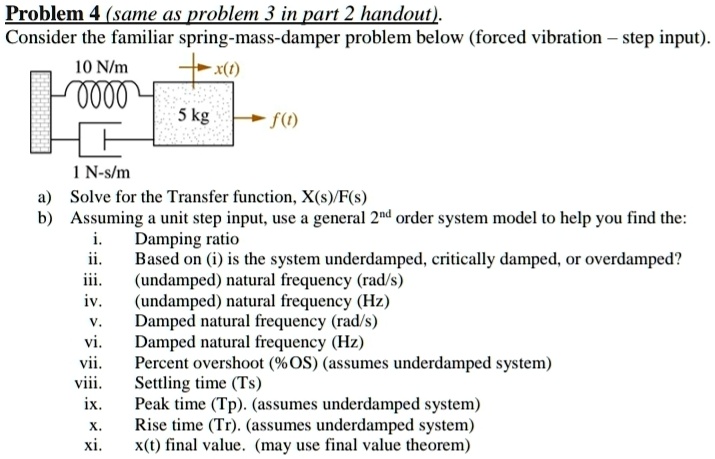
Problem 4 (same as problem 3 in part 2 handout). Consider the familiar spring-mass-damper problem below (forced vibration - step input). 10 N/m 0000 1 N-s/m 5 kg x(t) f(t) a) Solve for the Transfer function, $X(s)/F(s)$ b) Assuming a unit step input, use a general 2$^{nd}$ order system model to help you find the: i. Damping ratio ii. Based on (i) is the system underdamped, critically damped, or overdamped? iii. (undamped) natural frequency (rad/s) iv. (undamped) natural frequency (Hz) v. Damped natural frequency (rad/s) vi. Damped natural frequency (Hz) vii. Percent overshoot (% OS) (assumes underdamped system) viii. Settling time (Ts) ix. Peak time (Tp). (assumes underdamped system) x. Rise time (Tr). (assumes underdamped system) xi. x(t) final value. (may use final value theorem)
View Answer
divider
BEST MATCH

1-8 Find the eigenvalues of the given matrix. 1. $\begin{bmatrix} 2 & 0\\ 0 & 5 \end{bmatrix}$ 2. $\begin{bmatrix} 3 & 0 & 0\\ 0 & 4 & 0\\ 0 & 0 & 7 \end{bmatrix}$ 3. $\begin{bmatrix} 5 & 1\\ 4 & 5 \end{bmatrix}$ 4. $\begin{bmatrix} 3 & 5\\ 3 & 1 \end{bmatrix}$ 5. $\begin{bmatrix} 2 & 0 & 0\\ -1 & 3 & 3\\ 6 & -6 & -6 \end{bmatrix}$ 6. $\begin{bmatrix} 0 & 1 & 2\\ -4 & 1 & 4\\ -5 & 1 & 7 \end{bmatrix}$ 7. $\begin{bmatrix} 4 & 1 & 6\\ 0 & 2 & 3\\ 0 & 0 & 9 \end{bmatrix}$ 8. $\begin{bmatrix} 1 & 4 & 0 & 0\\ 0 & 2 & 0 & 0\\ 5 & 3 & 1 & 1\\ 4 & 7 & 2 & 2 \end{bmatrix}$

View Answer
divider
BEST MATCH

5. (a) The number $\frac{8}{7}$ = 1.14285714285714... obviously has no exact representation in any decimal floating point system ($\beta$ = 10) with finite precision t. Is there a finite floating point system (i.e., some finite integer base $\beta$ and precision t) in which this number does have an exact representation? If yes, then describe such a system. (b) Answer the same question for the irrational number $\pi$.

View Answer
divider
BEST MATCH

Directions: Use the function $f(x)$ below to answer the following questions. Part 1: Intervals of Concavity Find the open interval(s) on which $f$ is concave up / concave down. Part 2: Inflection Points Find the $x$-values(s) where $f$ has an inflection point. $f(x) = \frac{x - 8}{x - 2}$ Concave Up: Concave Down:

View Answer
divider
BEST MATCH

8. Let $f(x, y) = 2x^2 - 3xy + 3y^2$. Using the gradient descent method starting from $x = \begin{pmatrix} 3 \ 2 \end{pmatrix}$ and using variable step sizes find the second iteration. Comment on your result. 120 mark

View Answer
divider