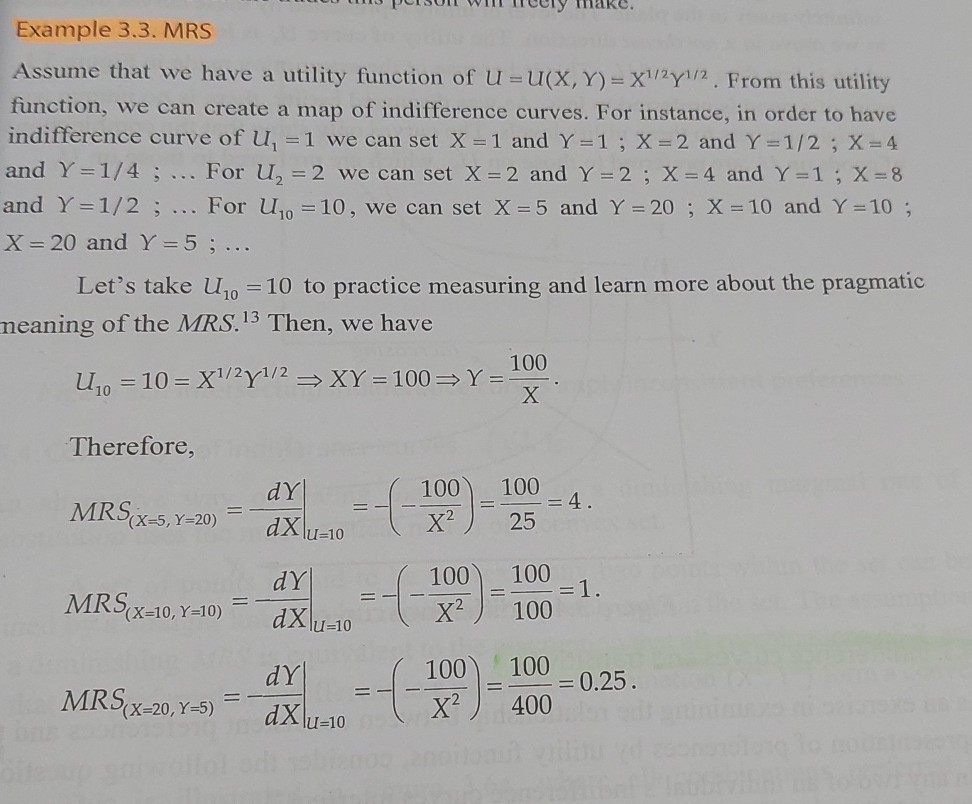
Example 3.3. MRS
Assume that we have a utility function of \( U=U(X, Y)=X^{1 / 2} Y^{1 / 2} \). From this utility function, we can create a map of indifference curves. For instance, in order to have indifference curve of \( U_{1}=1 \) we can set \( X=1 \) and \( Y=1 ; X=2 \) and \( Y=1 / 2 ; X=4 \) and \( Y=1 / 4 ; \ldots \) For \( U_{2}=2 \) we can set \( X=2 \) and \( Y=2 ; X=4 \) and \( Y=1 ; X=8 \) and \( Y=1 / 2 ; \ldots \) For \( U_{10}=10 \), we can set \( X=5 \) and \( Y=20 ; X=10 \) and \( Y=10 \); \( X=20 \) and \( Y=5 ; \ldots \)
Let's take \( U_{10}=10 \) to practice measuring and learn more about the pragmatic neaning of the MRS. \( { }^{13} \) Then, we have
\[
U_{10}=10=X^{1 / 2} Y^{1 / 2} \Rightarrow X Y=100 \Rightarrow Y=\frac{100}{X}
\]
Therefore,
\[
\begin{array}{l}
M R S_{(X=5, Y=20)}=\left.\frac{d Y}{d X}\right|_{U=10}=-\left(-\frac{100}{X^{2}}\right)=\frac{100}{25}=4 \\
M R S_{(X=10, Y=10)}=\left.\frac{d Y}{d X}\right|_{U=10}=-\left(-\frac{100}{X^{2}}\right)=\frac{100}{100}=1 \\
M R S_{(X=20, Y=5)}=-\left.\frac{d Y}{d X}\right|_{U=10}=-\left(-\frac{100}{X^{2}}\right)=\frac{100}{400}=0.25
\end{array}
\]