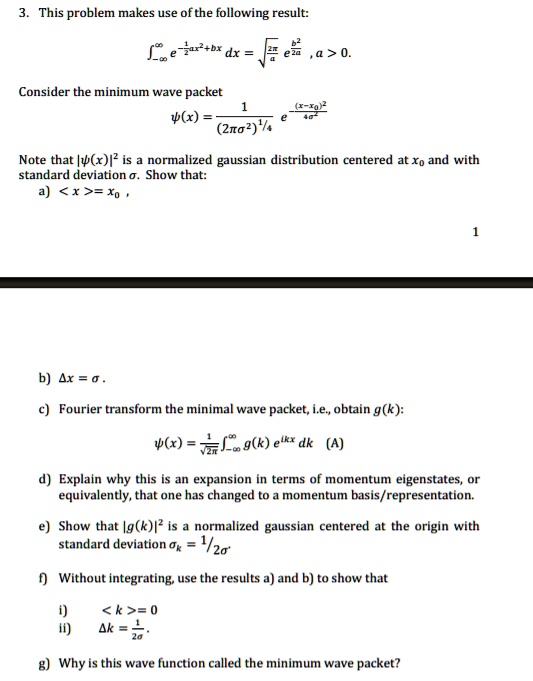
3. This problem makes use of the following result:
\int_{-\infty}^{\infty} e^{-\frac{1}{2}ax^2+bx} dx = \sqrt{\frac{2\pi}{a}} e^{\frac{b^2}{2a}}, a > 0.
Consider the minimum wave packet
\psi(x) = \frac{1}{(2\pi\sigma^2)^{1/4}} e^{-\frac{(x-x_0)^2}{4\sigma^2}}
Note that $|\psi(x)|^2$ is a normalized gaussian distribution centered at $x_0$ and with
standard deviation $\sigma$. Show that:
a) $<x> = x_0$,
b) $\Delta x = \sigma$.
c) Fourier transform the minimal wave packet, i.e., obtain $g(k)$:
$\psi(x) = \frac{1}{\sqrt{2\pi}} \int_{-\infty}^{\infty} g(k) e^{ikx} dk$ (A)
d) Explain why this is an expansion in terms of momentum eigenstates, or
equivalently, that one has changed to a momentum basis/representation.
e) Show that $|g(k)|^2$ is a normalized gaussian centered at the origin with
standard deviation $\sigma_k = \frac{1}{2\sigma}$
f) Without integrating, use the results a) and b) to show that
i) $<k> = 0$
ii) $\Delta k = \frac{1}{2\sigma}$
g) Why is this wave function called the minimum wave packet?