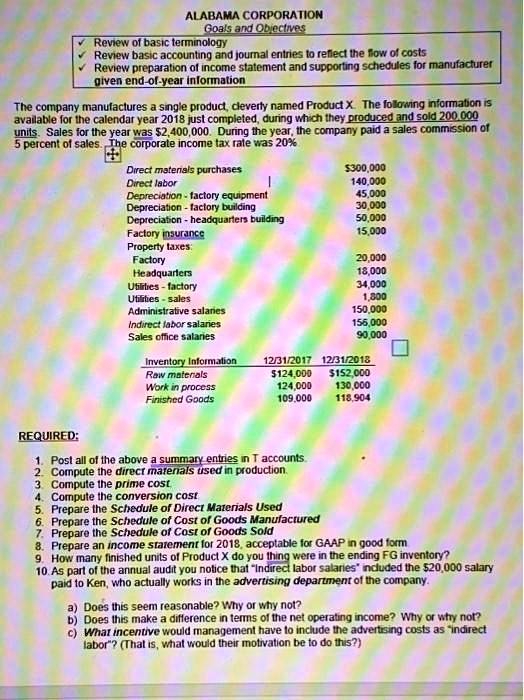
Texts: ALABAMA CORPORATION Goals and Objectives Review of basic terminology Review basic accounting and journal entries to reflect the flow of costs Review preparation of income statement and supporting schedules for manufacturer given end-of-year information
The company manufactures a single product cleverly named Product X. The following information is available for the calendar year 2018 just completed, during which they produced and sold 200,000 units. Sales for the year were $2,400,000. During the year, the company paid a sales commission of 5 percent of sales. The corporate income tax rate was 20%.
Direct materials purchases $300,000
Direct labor $140,000
Depreciation - factory equipment $45,000
Depreciation - factory building $30,000
Depreciation - headquarters building $50,000
Factory insurance $15,000
Property taxes - Factory $20,000
Property taxes - Headquarters $18,000
Utilities - factory $34,000
Utilities - sales $1,800
Administrative salaries $150,000
Indirect labor salaries $155,000
Sales office salaries $6,000
Inventory Information:
Raw materials
Work in process
Finished goods
12/31/2017 12/31/2018
$124,000 $152,000
124,000 130,000
109,000 118,904
REQUIRED:
1. Post all of the above summary entries in T accounts
2. Compute the direct materials used in production
3. Compute the prime cost
4. Compute the conversion cost
5. Prepare the Schedule of Direct Materials Used
6. Prepare the Schedule of Cost of Goods Manufactured
7. Prepare the Schedule of Cost of Goods Sold
8. Prepare an income statement for 2018 acceptable for GAAP in good form
9. How many finished units of Product X do you think were in the ending finished goods inventory?
10. As part of the annual audit, you notice that indirect labor salaries included the $520,000 salary paid to Ken, who actually works in the advertising department of the company.
a. Does this seem reasonable? Why or why not?
b. Does this make a difference in terms of the net operating income? Why or why not?
c. What incentive would management have to include the advertising costs as indirect labor? That is, what would their motivation be to do this?